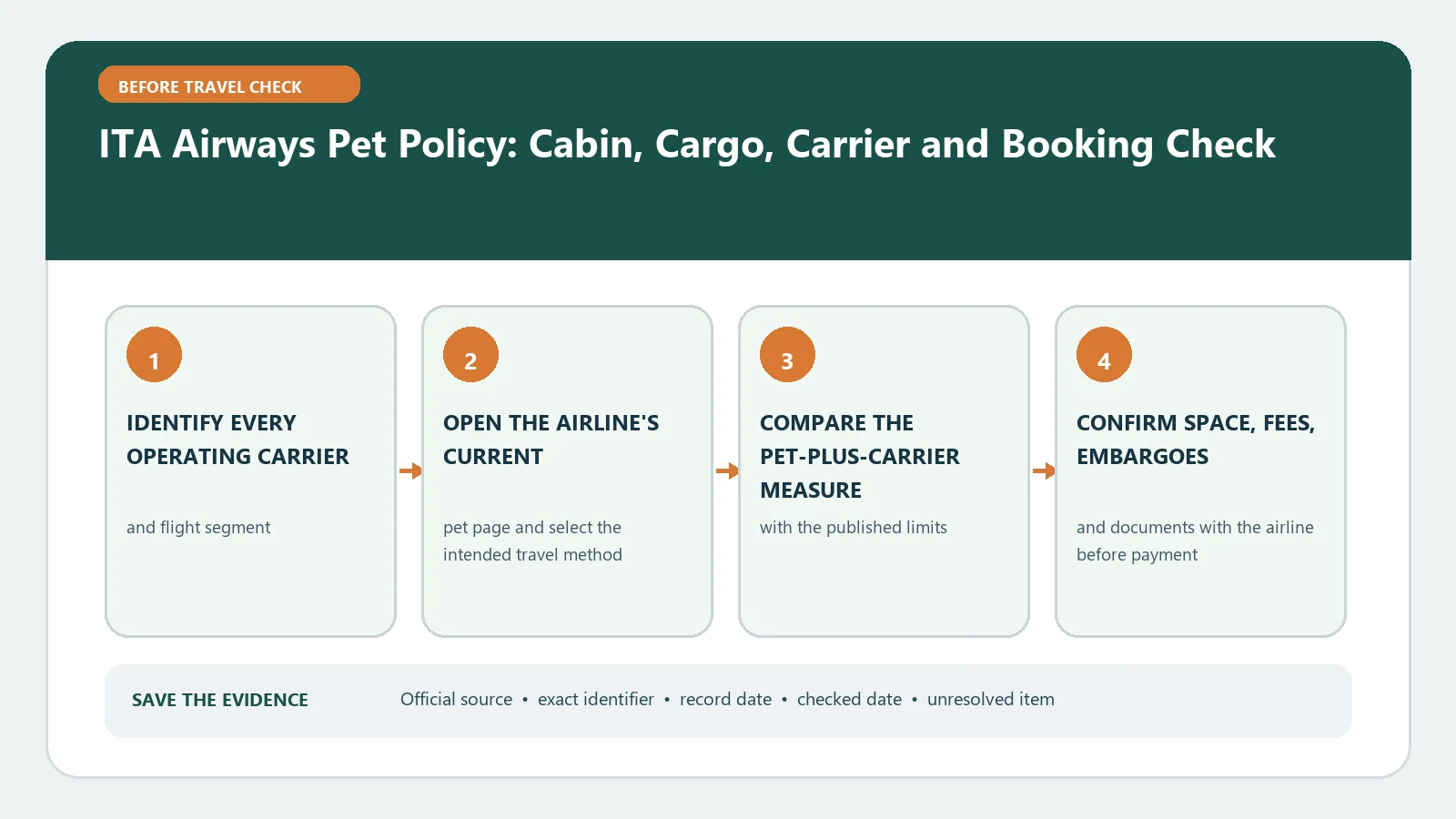
Before booking ITA Airways with a pet, identify every operating segment and ask ITA to accept the exact dog or cat, travel mode and container. A general statement that pets are carried is not a reservation. A usable result is a confirmed service linked to the booking, a container that meets the rule for that aircraft, and a separate document file for departure, transit and arrival.
Official routes checked August 26, 2026: ITA Airways. Open the pet hub for the current cabin or hold page and compare it with the conditions of carriage for the booked route. Recheck after an animal, operating flight, airport, date or custody change.
Confirm the operator on each segment
Read the flight details, not only the airline code at the top of the ticket. Record the marketing carrier, operating carrier, flight number, date, aircraft when shown, origin, connection and destination for every sector. ITA can approve only the parts it operates. A partner leg may apply another species, mode, container or embargo rule even when one ticket number covers the journey.
Use the codeshare pet booking check when the itinerary names another operator. Do not rely on an answer about the first flight to infer acceptance on the connection or return. Put one acceptance owner beside each segment before paying a nonrefundable fare.
Choose cabin or hold from the current animal page
The ITA Airways travelling-with-pets hub routes passengers to separate cabin, hold, assistance-dog and document instructions. Start with species, age, combined animal-and-container weight, container type and route. Copy the current limit from the relevant page into a dated trip sheet rather than carrying forward a number from an old itinerary or product listing.
| Decision | Evidence to record | Reason to stop |
|---|---|---|
| Operating segment | Carrier and flight for every leg | A partner leg has no pet answer |
| Travel mode | Cabin or hold response for this animal | The response says only pets allowed |
| Container | Dimensions, construction and loaded weight | Only a retailer label is available |
| Booking state | Service reference and payment state | A request exists without confirmation |
| Border file | Departure, transit and arrival documents | Airline approval is the only evidence |
Measure the loaded container before requesting space
Measure the container at its widest rigid or filled points. For a soft cabin carrier, include seams, base and natural bulge when the animal turns. For a hold kennel, record length, width, height, ventilation faces, door hardware, fasteners, bowls and disabled or removed wheels. Weigh the animal and travel-ready container together on one scale and retain a photograph of the reading.
The carry-on carrier measurement guide helps with a cabin case, while the crate hardware and ventilation check covers a rigid hold kennel. Aircraft clearance can be narrower than a general allowance, so give ITA actual measurements rather than asking which product to buy.
Turn the request into a booking-linked record
Contact the channel named on the current ITA page with the booking reference, passenger, animal, container, loaded weight and every operating flight. Ask the agent to read back the travel mode and sectors covered. Record request time, channel, service reference, payment or ticketing state, and airport instruction. A message sent to customer service is not the same as confirmed pet capacity.
Use the pet reservation confirmation guide to distinguish requested, waitlisted, confirmed and paid states. If ITA cannot provide space, ask whether another ITA-operated flight is eligible before changing the date. Do not move only the passenger and assume the animal service follows.
Keep transport papers and border papers separate
The ITA Airways conditions of carriage place responsibility for valid health, vaccination, entry and transit records on the passenger. Build one airline folder containing the service confirmation and container facts, and one authority folder containing the exact records required by every country that may examine the animal. ITA acceptance cannot waive a permit, and a certificate cannot create capacity.
Build one clock for booking and document deadlines
Put scheduled border arrival at the right edge of a timeline. Working backward, add any permit approval, vaccination or treatment window, veterinarian issuance, government endorsement, ITA document presentation, pet-service payment and airport reporting time. Name the time zone beside each event. This prevents a clinic appointment based on flight departure from missing a rule measured from arrival.
Give each deadline an owner and evidence field. The veterinarian owns issuance, the public authority owns permit or endorsement, ITA owns service and check-in, and the traveler owns the final comparison. If one date moves, recalculate downstream events instead of changing a single cell. Keep screenshots only as supporting evidence; the current official page and live booking response remain controlling.
Treat a connection as a custody problem
Ask who holds the animal during each transfer, whether it remains checked through, whether it must be collected, and where any inspection occurs. If the itinerary changes terminals, airports or operating carriers, obtain a new answer for the handoff. A legal passenger transit can still fail when staff cannot transfer the kennel or the animal must formally enter the connection country.
Revalidate the exact field that changed
After an aircraft swap, recheck container clearance and mode. After a date change, recheck capacity, seasonal restrictions and document windows. After a route change, reopen the operator and border files. Ask ITA to replace or reconfirm the service on the new segments, then save the revised record beside the old one marked superseded.
Before leaving for the airport, perform a read-back with another adult. One person reads the itinerary, animal identity, loaded measurements, service state and document dates; the other points to the source record. Resolve any unexplained difference while the contact centers and issuing offices are open. Carry the contact route and case reference for each owner, not a loose collection of policy screenshots.
At check-in, present one consistent animal, container, booking and document packet. That packet proves preparation for one journey; it does not guarantee carriage. ITA may refuse the animal if live measurements, condition, container, documents, aircraft or operations fail the current check. Keep a named caretaker or eligible later flight as recovery.