Quick answer: For a Korean Air pet booking, verify the operating carrier, route, aircraft, and requested travel method before buying a carrier or completing health documents. The itinerary must satisfy the airline's current acceptance rule and the separate entry rules for the destination and transit points.
Confirm four things before relying on the Korean Air pet rule
- Open the live Korean Air guide for the exact cabin or hold process.
- Check the total animal-plus-carrier limit and the carrier measurements for the operating aircraft.
- Request pet acceptance through the airline and retain the confirmation for every segment.
What this result does not prove
A passenger booking and a compliant carrier do not reserve pet capacity. Codeshare operation or an aircraft change can produce a different answer.
Verify the live rule at Korean Air's official pet guide. Then continue with the entry-document check for the next step.
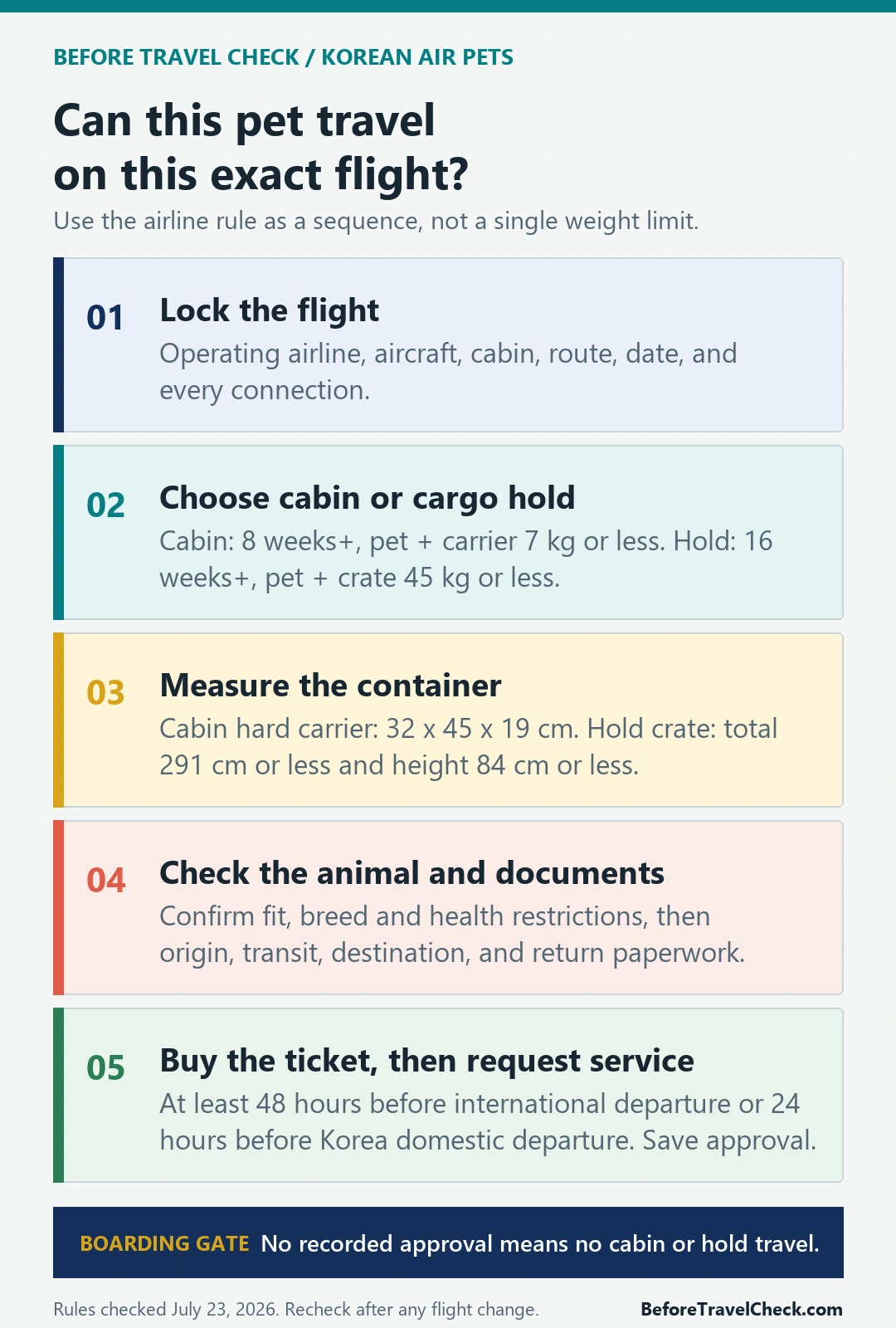
Korean Air accepts eligible dogs, cats, and pet birds, but acceptance depends on the exact flight, the animal’s age and condition, the combined weight, the carrier, and advance approval. For cabin travel, the current limit is 7 kg (15 lb) for the pet and carrier together. For the cargo hold, it is 45 kg (99 lb) together. Do not arrive with a pet based only on those numbers: Korean Air says an unapproved pet cannot travel in the cabin or the hold.
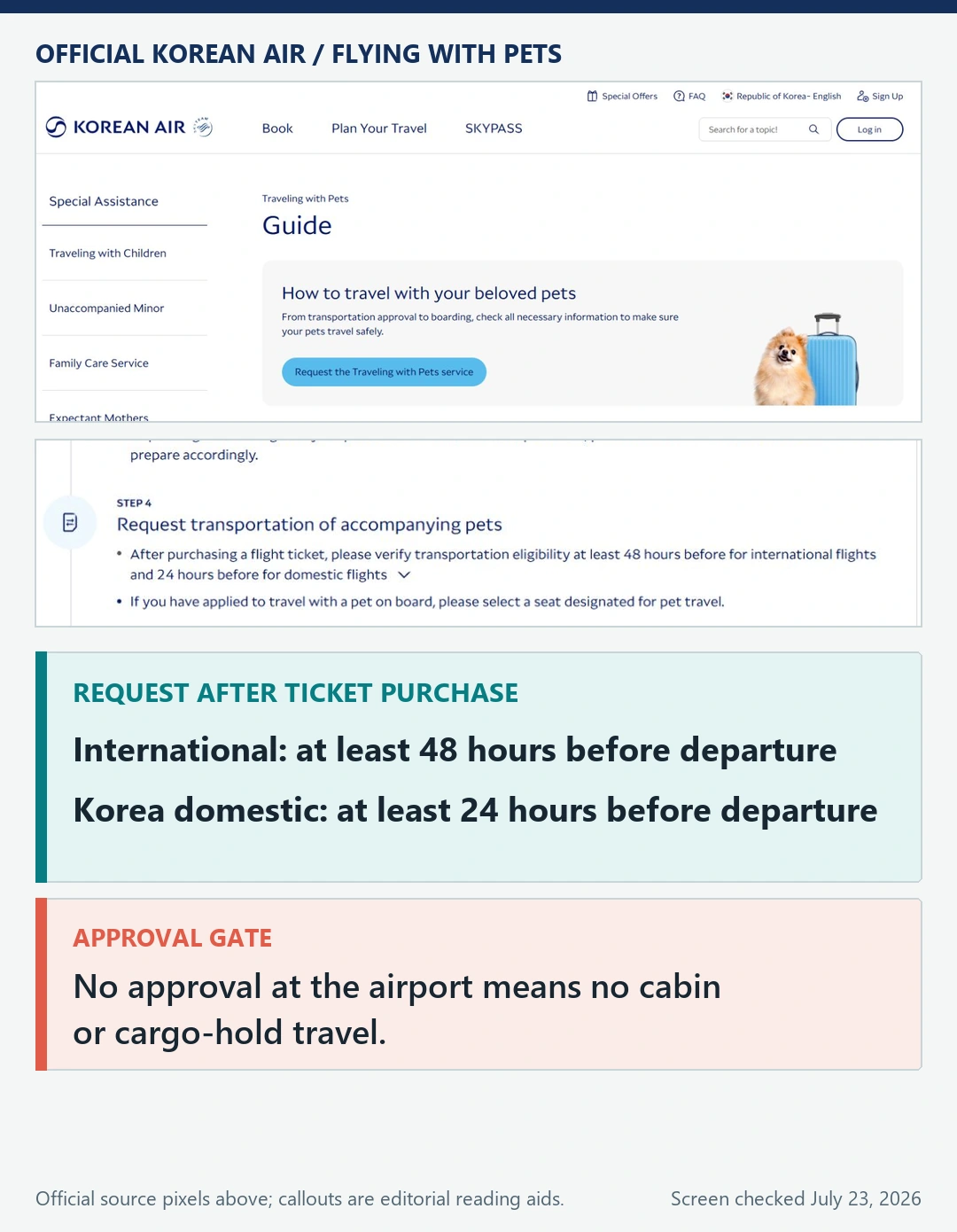
The practical order is to check the operating carrier and aircraft before paying for a nonrefundable itinerary, buy the passenger ticket, then request the pet service promptly. Korean Air currently asks for the request at least 48 hours before an international departure or 24 hours before a Korea domestic departure. Government entry, transit, and return documents remain a separate job.
Policy checked July 23, 2026. Aircraft assignments, country rules, seasonal restrictions, and available pet space can change. Reopen the airline’s live guide for the booked itinerary.
Check the exact flight before measuring the carrier
Start with the company operating each flight segment, not only the KE flight number printed on the ticket. A codeshare can carry Korean Air branding while another airline operates the aircraft, and the partner’s pet rule may control that segment. Record the operating carrier, aircraft, cabin, date, origin, destination, and every connection.
Korean Air’s Flying with Pets guide says restrictions can vary by aircraft, cabin class, airport, and entry or exit regulations. The page also lists checked-pet restrictions for Boeing 737 and Airbus A321 international flights and for Korea domestic flights from June through September. Treat an aircraft change as a reason to reconfirm, not as a minor schedule detail.
| Check | Cabin | Cargo hold |
|---|---|---|
| Minimum age | 8 weeks | 16 weeks |
| Pet + carrier | 7 kg (15 lb) or less | 45 kg (99 lb) or less |
| Carrier or crate | Must fit under the seat; airline dimensions apply | Total dimensions 291 cm (114 in) or less; height 84 cm (33 in) or less |
| Typical booking limit | One pet per passenger | Up to two pets per passenger |
| Important exclusion | Seat, cabin, and itinerary can restrict use | Brachycephalic breeds are not accepted in the hold |
These are screening figures, not a reservation. Korean Air can limit the number of animals on a flight, and some countries restrict transport above 32 kg (70 lb) even though the airline’s general hold limit is higher.
Cabin travel: the combined limit is 7 kg
For the cabin, the pet must be at least 8 weeks old and the pet plus carrier must weigh no more than 7 kg. Korean Air currently gives a hard-carrier maximum of 32 cm wide x 45 cm deep x 19 cm high. A soft carrier may be up to 25 cm high only if it compresses to no more than 19 cm and still fits under the seat.
Measure the outside at the widest points, including the base, frame, wheels, handles that do not fold away, and reinforced pockets. Then run a separate animal-fit test. The pet needs enough room to stand, lie down, and move inside the closed carrier. A soft roof that reaches 19 cm only by pressing onto the animal does not solve the fit problem.
- Weigh the animal and carrier together on the same scale.
- Write the external width, depth, and natural height in centimetres.
- Confirm the carrier fits the under-seat space for the booked aircraft and seat.
- Keep the pet inside the carrier during the flight; Korean Air says it cannot be taken out onboard.
One passenger normally travels with one cabin pet. Korean Air lists narrow exceptions for two young dogs or two cats, or a pair of birds, sharing one compatible container. Do not assume the exception applies without the airline confirming the exact animals and carrier.
Cargo hold travel has separate age and crate limits
A pet in the cargo hold must be at least 16 weeks old. The combined animal-and-crate weight must be 45 kg or less, while the sum of the crate’s length, width, and height must be 291 cm or less and the height must be 84 cm or less. Korean Air notes that some countries restrict transport once the total exceeds 32 kg.
The crate must be sturdy, properly ventilated, water resistant, secured so the animal cannot force it open, and large enough for the pet to stand, lie down, and move. Wheels and other movable accessories need to be removed or immobilized according to the live carrier conditions. A cabin bag and a hold crate are not interchangeable purchases.
Korean Air does not accept brachycephalic, or short-nosed, breeds in the cargo hold. A short-nosed pet may travel in the cabin only when it satisfies every cabin condition and receives approval. The airline also restricts aggressive animals, sedated animals, pregnant animals, and animals with a strong odor. Discuss health and sedation questions with a veterinarian rather than treating an airline acceptance rule as medical advice.
Request approval before the deadline
Korean Air requires the passenger ticket before the pet-service request. After buying an itinerary that appears eligible, use the airline’s Traveling with Pets service request or contact the service center. Submit the request at least 48 hours before an international flight or 24 hours before a Korea domestic flight.
- Check the operating airline, aircraft, cabin, route, and travel date on every segment.
- Confirm that the animal type, age, condition, weight, and proposed travel method fit the live guide.
- Measure and weigh the pet and carrier or crate before making the service request.
- Buy the passenger ticket, then request pet transport before the applicable deadline.
- Save the approval and check that it covers every Korean Air-operated segment.
Do not read a fee payment, a general call-center answer, or a policy-page screenshot as approval. Korean Air states that a pet arriving at the airport without approval cannot travel in the cabin or cargo hold. Pet space can sell out before the formal deadline, so waiting until the last permitted hour adds avoidable risk.
Airline approval does not replace entry documents
Korean Air decides whether it can carry the pet. Government authorities decide whether the animal may leave, transit, enter, and return. A rabies record, microchip, health certificate, import permit, quarantine certificate, parasite treatment, or official endorsement may be required on a timetable that does not match the airline’s 48-hour or 24-hour request deadline.
Build the document plan from the destination, every transit country, the origin, and the return destination. Use our pet travel health certificate guide to identify the document questions, and the USDA APHIS pet travel guide when the trip starts in the United States. The IATA traveler information on pets is useful background, but the responsible government authority and the operating airline control the trip.
Compare names, microchip numbers, vaccination dates, certificate dates, and flight details before leaving home. A document can be genuine and still fail the trip if its identifier or timing does not match the animal and route.
Codeshares and connections can change the answer
A Korean Air flight number does not prove Korean Air operates the aircraft. Open the itinerary and find the words “operated by” for each segment. Korean Air says pet travel on a codeshare may depend on the partner’s policy, so contact the service center when another carrier appears anywhere in the booking.
Connections add airport and border questions as well as airline questions. Ask whether the pet remains checked through, must be collected, needs a transit document, or has enough connection time for an animal handoff. If two carriers give conflicting instructions, pause the booking until both segment owners confirm a workable sequence.
This page covers pets, not trained service animals. Korean Air publishes a separate service-animal guide; do not apply pet carrier, fee, or booking assumptions to that process.
Keep the approval details with the booking
After approval, keep one travel folder with the passenger booking, pet-service confirmation, measured carrier dimensions, combined weight, government documents, and contact details for the airline and relevant quarantine office. Recheck the flight after any schedule or aircraft change.
- Proceed: every operating segment is eligible, the carrier and animal fit, documents are valid, and pet approval is recorded.
- Pause: the aircraft, partner policy, available pet space, document timing, or approval status is uncertain.
- Change the plan: the animal cannot meet the travel-method conditions or a route, aircraft, season, health, or country restriction blocks transport.
The broader pet travel checklist before you fly can hold the airport-day tasks that do not belong in an airline policy check. Keep carrier acclimation, feeding, water, relief, labels, and emergency contacts beside the approval paperwork.
Korean Air pet policy questions
Can I bring a pet to the airport without advance approval?
No. Korean Air says a pet without approval cannot travel in the cabin or cargo hold. A passenger ticket alone does not reserve pet space.
What is the Korean Air cabin pet weight limit?
The current combined limit is 7 kg (15 lb) for the pet and carrier. The carrier must also meet the size and under-seat conditions, and the animal must fit safely inside it.
Can a soft carrier be 25 cm high?
It may be up to 25 cm high only when it can be pressed to 19 cm or less and still fits under the seat. Do not count compression that removes the animal’s usable space.
Can a short-nosed dog or cat travel in the hold?
No under Korean Air’s current guide. A brachycephalic pet can be considered for the cabin only if it meets all cabin conditions and receives approval.
Does Korean Air approval cover a codeshare partner?
Not automatically. Check the operating carrier on every segment and ask Korean Air how the partner’s policy affects the booking before relying on the approval.
Where to confirm the current rule
This independent guide was checked against Korean Air’s Flying with Pets guide and pet-service request page on July 23, 2026. The airline’s approval applies to carriage; government animal-entry and quarantine authorities control admissibility and documents for a specific route.