An “airline approved” label on a cat carrier is not an approval for your flight. A cabin carrier has to pass three separate checks: the operating airline must accept a cat on the route, the loaded carrier must fit the aircraft’s under-seat limit, and the cat must fit safely inside the closed carrier. A product can pass one check and fail another.
Choose the flight before the carrier whenever possible. Save the operating airline, aircraft, cabin, seat, route, and the policy page you checked. Then measure the exact carrier you will take, with its base pad, pockets, handles, and any frame installed. Do not rely only on a retailer’s dimensions or a badge printed on the bag.
There is no universal airline-approved cat carrier
Airlines publish different limits and apply them in different ways. American Airlines currently lists separate measurements for recommended soft-sided carriers, hard-sided carriers on mainline flights, and hard-sided carriers on American Eagle flights. Delta says the maximum depends on the aircraft and recommends a soft-sided size that fits most aircraft. Those two official policies are enough to show why a seller cannot certify one bag for every airline, aircraft, cabin, and seat.
The useful question is not “Is this carrier airline approved?” Ask: “Will this measured, loaded carrier fit under my assigned seat on every operated segment, while my cat remains safely inside it?” Keep any airline answer with the reservation because a codeshare flight, aircraft swap, or seat change can alter the practical limit.
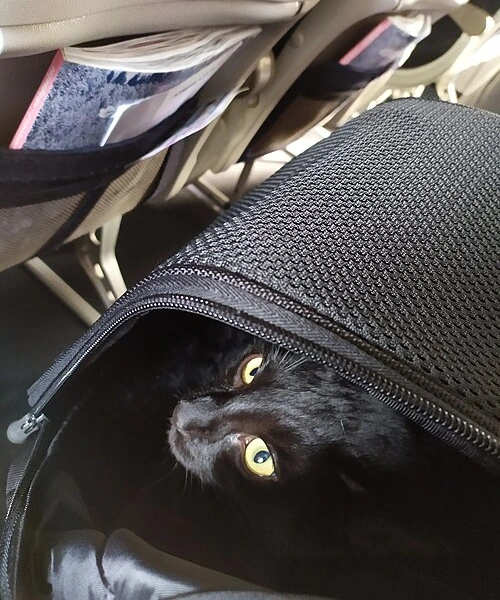

Start with the operating airline and aircraft
- Open the itinerary and find the words operated by for every segment. The marketing airline’s flight number does not replace the operating carrier’s pet rule.
- Confirm that a cat is accepted in the cabin on the origin, connection, and destination route. Some destinations and premium cabins do not allow an in-cabin pet.
- Record the aircraft type and seat restrictions. Bulkhead, exit-row, flat-bed, and no-stowage seats commonly create problems because there may be no usable under-seat space.
- Reserve the pet, not just the passenger seat. Airlines can cap the number of in-cabin animals on a flight.
- Ask the operating airline which under-seat limit applies if its public page gives more than one number or tells passengers to verify the aircraft.
Repeat that check after a schedule or aircraft change. A confirmation that was correct when you booked may not describe the replacement aircraft. The carrier should be selected from the strictest confirmed segment, not from the roomiest one.
Pass the three fit gates before you buy
Gate 1 is route acceptance. The airline must permit a cat in the cabin on the exact itinerary and in the chosen cabin. Gate 2 is carrier fit. The exterior must fit fully in the permitted under-seat space without blocking an aisle or being crushed so far that the usable interior disappears. Gate 3 is animal fit. The cat must remain comfortably contained with the carrier closed, with secure closures and the ventilation required by the airline.
Do not trade one gate for another. A smaller bag may fit the aircraft but be unsuitable for the cat. A roomy carrier may be comfortable at home but fail under the seat. A perfect physical fit still does not create route permission or satisfy the destination’s animal-entry documents.
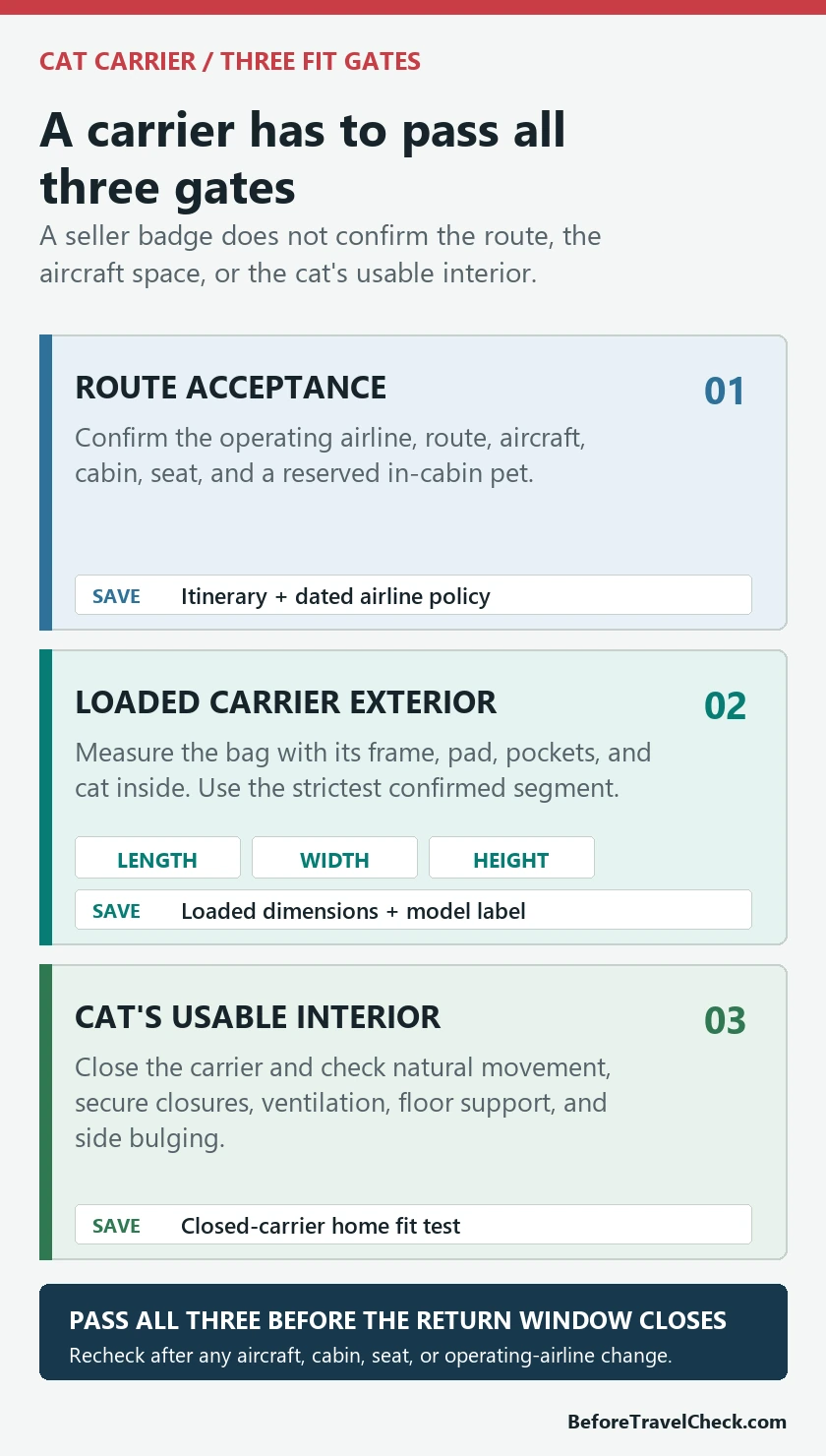
Measure the carrier as you will travel with it
- Exterior length: measure the longest point, including a rigid frame or pocket that cannot be flattened.
- Exterior width: measure the loaded bag at its widest point, not an empty bag pressed flat for a product photo.
- Exterior height: include the base and top structure. A soft top may flex, but it should not have to collapse onto the cat.
- Usable interior: subtract padding, a reinforced floor, inward-bowing mesh, and anything stored inside.
- Loaded condition: repeat the exterior measurement with the normal pad and the cat inside because soft sides can bulge.
- Combined weight: record the cat, carrier, and installed accessories if the airline applies a weight limit to that aircraft or service.
Use a rigid ruler or tape against a wall and photograph the three exterior measurements. Photograph the model label too. These records make a later call with the airline specific: you can give measured dimensions rather than asking whether a brand name is accepted.
Use current airline dimensions as examples, not a universal limit
The following figures were checked on official airline pages on July 25, 2026. They are examples of why the itinerary controls the decision. Open the live policy again before purchase and before departure.
| Official example | Published carrier figure | What still needs checking |
|---|---|---|
| American Airlines, soft-sided | 18 × 11 × 11 in / 46 × 28 × 28 cm | The carrier must fit under the seat without excessive collapse; route, cabin, seat, and aircraft restrictions still apply |
| American Airlines, hard-sided mainline | 19 × 13 × 9 in / 48 × 33 × 22 cm | A non-collapsible kennel cannot exceed the under-seat dimensions of any aircraft in the journey |
| American Eagle, hard-sided | 16 × 12 × 8 in / 40 × 30 × 20 cm | Regional aircraft and cabin pet limits can differ from mainline flights |
| Delta, soft-sided recommendation | 18 × 11 × 11 in | Delta says the maximum is aircraft-specific and the carrier must fit fully under the seat |
American also says a carry-on pet must stay in the carrier and under the seat for the flight. Delta requires the cat to fit comfortably, move without touching or sticking out from the sides, and remain in a carrier that fits fully under the seat. A matching number on a product page is therefore only the start of the fit check.
Run a closed-carrier test before the return window closes
- Set up the carrier exactly as it will be used, including the base pad and any permitted absorbent liner.
- Check every zipper, latch, seam, and mesh panel. Use the airline’s closure and ventilation rules, not a retailer’s general claim.
- Let the cat enter voluntarily when possible, then close the carrier and watch the usable space. The cat should not be forced into a posture created by collapsing the roof or sides.
- Carry the loaded bag by its normal handles and shoulder strap. Look for floor sag, side bulging, a zipper under tension, or a frame that changes the measured dimensions.
- Place the carrier in a taped floor rectangle matching the confirmed under-seat footprint. Add a height guide so a flexible top is not counted as unlimited space.
- Practice a calm period in the closed carrier before the store’s return deadline. Increase duration gradually and discuss severe distress, breathing concerns, or medication with a veterinarian rather than improvising on travel day.
A home test cannot guarantee airport acceptance, but it can expose obvious failures while the bag can still be returned: an escape-prone zipper, poor ventilation, a sagging base, a cat that cannot settle, or a loaded exterior larger than the advertised size.
Do not confuse cabin, checked, and cargo requirements
A flexible under-seat carrier and a rigid transport kennel solve different problems. IATA’s Live Animals Regulations inform animal transport, especially cargo operations, but the phrase “IATA approved” on a retail listing does not replace an airline’s acceptance check. American, for example, limits ordinary checked-pet acceptance to specific official-travel customers and routes other animals that are too large for the cabin to its cargo service.
Do not buy a cargo crate from a cabin-carrier article or assume a cabin bag can be checked at the counter. The construction, door, ventilation, food and water equipment, labeling, aircraft limits, and temperature controls can be different. Decide the travel method first, then use the policy for that method.
Prepare for check-in, security, and a changed aircraft
- Keep the pet reservation, fee information, carrier measurements, and the policy page checked for each operating airline.
- Recheck the aircraft and seat assignment 48 hours before departure and again at check-in.
- Use a secure harness and leash appropriate for the cat if the security process requires the animal to leave the carrier. Ask for a private screening room when available if escape is a concern.
- Carry destination and transit documents separately from the carrier purchase decision. The USDA APHIS Pet Travel route can help U.S. travelers find country-specific requirements, but the destination authority controls entry.
- Have a backup plan if the aircraft, seat, temperature, or route makes the booked pet movement unavailable. Do not assume the carrier badge requires the airline to accept it.
Questions about airline-approved cat carriers
Does 18 × 11 × 11 inches work on every airline?
No. American lists that figure for its recommended soft-sided carrier, and Delta recommends it because it fits most of its aircraft, but both policies still require aircraft and under-seat fit checks. Other airlines and partner-operated flights can use different limits.
Can a soft carrier be slightly larger than the limit?
Only when the operating airline’s current policy allows flexibility and the loaded carrier still fits safely. American says a soft-sided carrier can be slightly larger but must fit under the seat without being excessively collapsed. Do not turn that wording into permission for an oversized bag.
Should I choose the carrier before booking the flight?
Choose the itinerary first when you can. The operating airline, aircraft, cabin, seat, and route define the strictest carrier limit. If you already own a carrier, measure it loaded and use those exact numbers when selecting and confirming the flight.
Does an accepted carrier replace health or import documents?
No. Carrier acceptance, airline pet booking, veterinary preparation, transit rules, and destination entry are separate checks. Complete all of them for every segment and border crossing.
Official sources and related guides
- American Airlines pet travel and carrier limits
- Delta in-cabin pet and kennel requirements
- IATA Traveler’s Pet Corner
- USDA APHIS Pet Travel
- Airline Approved Pet Carrier: How to Check the Official Size Rule
- Airline Approved Cat Crate: What to Check Before You Buy
- American Airlines Pet Carrier Size: What to Check Before You Buy
Sources checked July 25, 2026. Airline policies, aircraft assignments, fees, and destination restrictions can change; use the live operating-airline page and reservation record for the final decision.