Quick answer: Air Canada pet carrier size is not a single number that can be applied to every itinerary. Confirm the operating aircraft, cabin, seat restrictions, and the airline's current pet-acceptance rule, then measure the carrier at its widest outside points in the shape it will have during travel.
Measure the carrier only after confirming the operating flight
- Check that the pet request can be accepted on every operated segment, including partner-operated flights.
- Measure external length, width, and height; do not use the product name or a seller's nominal size alone.
- Confirm that the animal can stand, turn, and lie naturally without treating a soft bag as infinitely compressible.
What this result does not prove
A carrier that fits the published dimensions is not automatically approved: aircraft changes, seat location, route restrictions, and limited pet capacity can still block travel.
Verify the live rule at Air Canada's current pet-travel page. Then continue with the full Air Canada pet-policy check for the next step.
There is not one Air Canada cabin pet carrier size that fits every booking. First find the operating aircraft and cabin. Air Canada’s current exception chart lists 40 cm wide x 43 cm long x 20 cm high for many mainline aircraft, 40 x 55 x 27 cm for listed regional aircraft and Landline connections, and 21 x 41 x 28 cm for Business Class on listed wide-body aircraft. These are external carrier limits, not a guarantee that the pet will be accepted.
Since June 1, 2025, a pet travelling in the cabin on Air Canada, Air Canada Rouge, or Air Canada Express must use a flexible, soft-sided carrier. The animal must still be able to stand, turn around, and lie down safely inside it. Check the live policy for the exact flight before buying a carrier or a non-refundable ticket.
Policy checked July 22, 2026. Aircraft assignments and pet rules can change before departure.
Find the operating aircraft before measuring the bag
Open the booking details and record the company operating each segment, the aircraft code, and the cabin. Do not stop at an Air Canada flight number. A flight marketed by Air Canada can be operated by a partner, and the operating carrier is what matters for pet carriage.
- Find the words “operated by” for every flight segment.
- Record the aircraft name and three-character code, such as 788 or DH4.
- Confirm the booked cabin and seat type, not only the fare name.
- Ask Reservations which carrier row applies if the aircraft is missing or unclear.
An aircraft swap can change the available under-seat space. Recheck the operating aircraft before the carrier return window closes and again shortly before departure.
Match the booking to the current aircraft row
The table below reorganizes the carrier-size exceptions on Air Canada’s current Travelling with your Pet page. Measurements are shown in the airline’s width, length, height order.
| Aircraft group / code | Max W x L x H |
|---|---|
| Listed mainline 223 319 320 321 333 7M8 77L 77W 788 789 | 40 x 43 x 20 cm 16 x 17 x 8 in |
| Regional + Landline DH4 E75 CR9 + Landline | 40 x 55 x 27 cm 16 x 22 x 10 in |
| Listed widebody Business 333 77L 77W 788 789 | 21 x 41 x 28 cm 8 x 16 x 11 in |
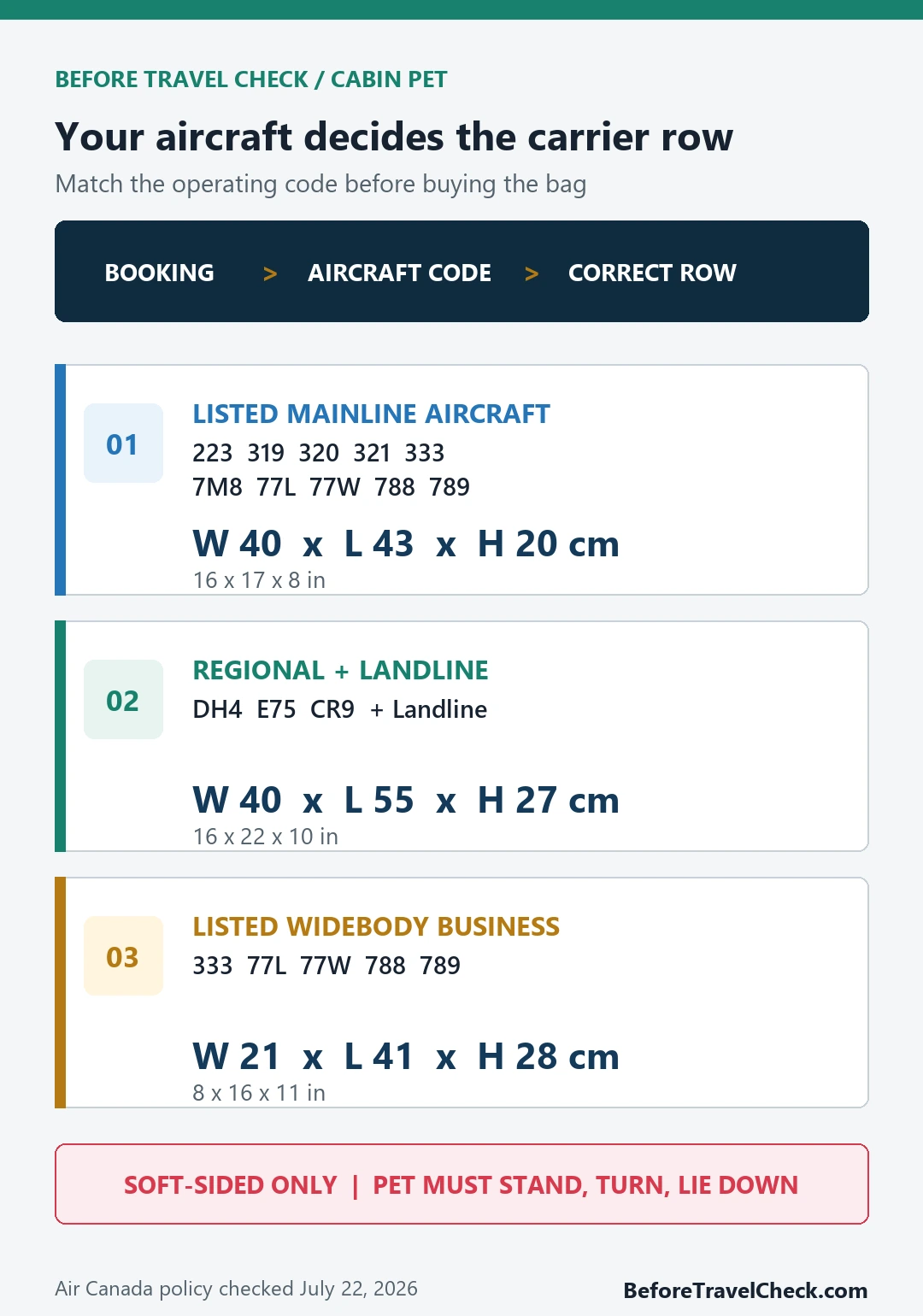
Do not choose the largest row simply because it is easier to satisfy. The correct row is the one tied to the aircraft and cabin on the itinerary. Air Canada also states that pet carriers are not permitted on Air Canada Jetz flights.
Measure the carrier at its widest external points
Manufacturer dimensions are a starting point, not proof. Put the empty carrier on a level floor and measure the outside at the widest, longest, and tallest points. Include the base, frame, reinforced corners, closed pockets, zipper track, and any structure that does not compress.
- Width: side to side at the widest rigid or reinforced point
- Length: front to back with the carrier fully closed
- Height: floor to the tallest point without pushing the roof onto the animal
- Weight: pet and carrier separately, then together for the reservation call
Soft-sided does not mean “any oversize bag can be squeezed under the seat.” Flexibility may help the carrier fit the space, but it cannot remove the animal’s usable headroom. A product label saying “airline approved” does not identify the aircraft, cabin, seat, route, or pet.
Write the measured centimetres and inches on the receipt or a note saved with the booking. A photograph of the tape measure can help you remember where each value came from, but it is not airline approval. If a support agent confirms the setup, repeat the aircraft code, cabin, and three dimensions back in the same order so a width-versus-height mix-up is caught before travel.
Run the animal-fit test at home
With the carrier on the floor and fully closed, watch the animal enter, stand, turn around, and settle into a natural lying position. No part of the pet should extend outside the carrier. If the roof has to press onto the animal to meet the measured height, the setup does not pass both tests.
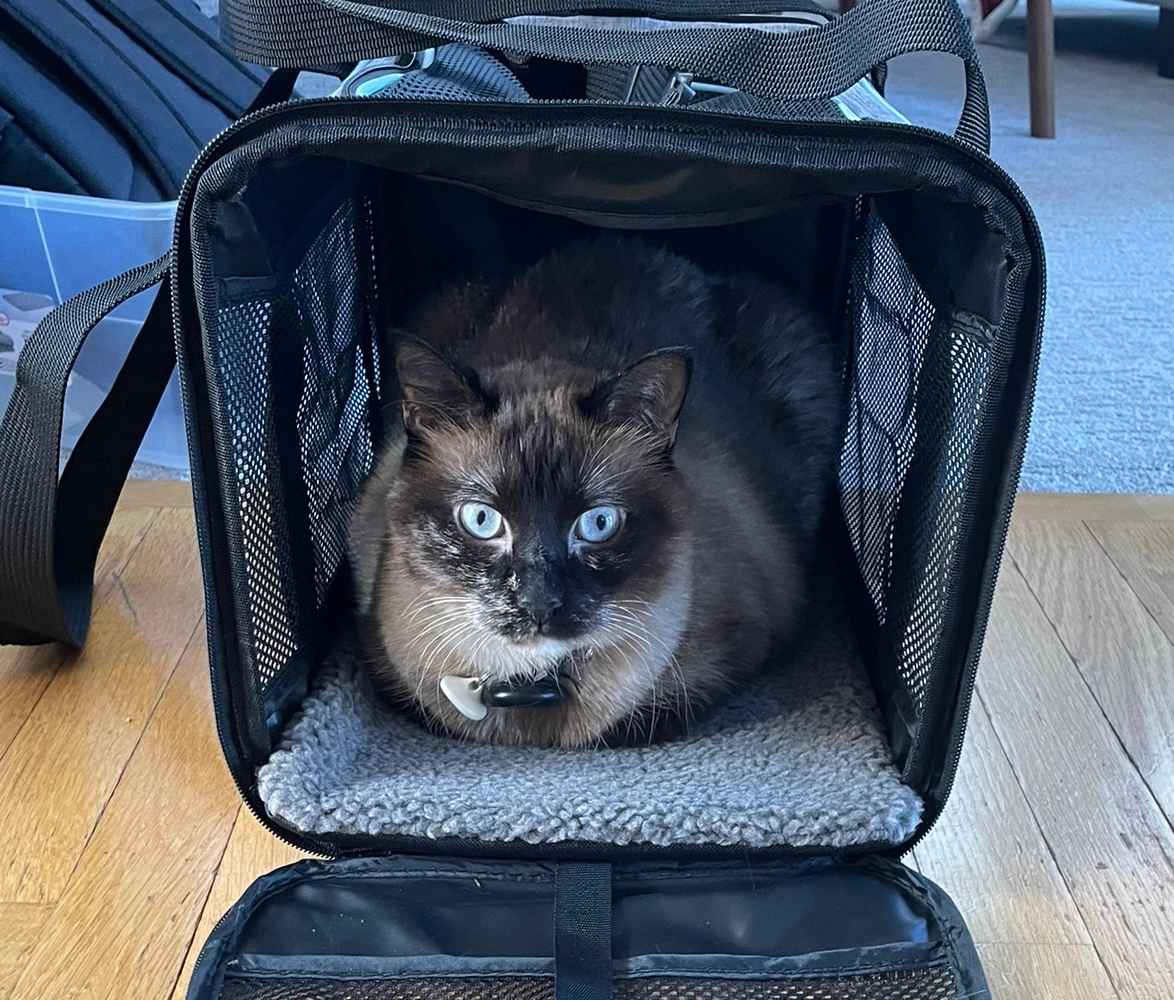

Check ventilation, secure closures, an absorbent base, and the pet’s response to being enclosed. The carrier in a home photograph can demonstrate material and usable space, but it cannot prove airline approval. Air Canada says the carrier must remain closed and under the seat during cabin travel.
Some seats and itineraries block cabin pet travel
A correctly measured carrier can still be unusable on the booked itinerary. Air Canada’s current page excludes cabin pets when the passenger is an unaccompanied minor, sits in an exit or bulkhead row, needs the under-seat area for a medical device, or travels in Premium Economy. It allows one cat or small dog in the cabin per passenger and says the pet must generally be at least 10 weeks old and fully weaned.
If any segment is marketed by Air Canada but operated by a codeshare partner, do not assume the Air Canada carrier chart follows the ticket. Air Canada’s page says a pet cannot travel on that codeshare arrangement and directs travelers to the operating carrier’s policy. Resolve this before paying for the carrier.
Register the pet after booking the passenger
Buying a passenger ticket does not reserve pet space. Air Canada instructs travelers to book their own flight first and then contact Reservations to register the pet. Have the carrier dimensions, pet weight, and breed ready. The airline strongly recommends doing this within 24 hours of booking, and says an unregistered pet will not be accepted at the airport.
- Choose a flight whose operating carrier, aircraft, cabin, and seat can take a cabin pet.
- Book the passenger under a fare whose change risk you understand.
- Call Reservations promptly and register the pet on every eligible segment.
- Record what was confirmed, including the dimensions and itinerary.
- Reconfirm the pet reservation after any flight or aircraft change.
Travelers with a pet must see an agent at check-in and cannot use online or airport self-service check-in. Air Canada says to arrive 30 minutes before its normal recommended check-in time, not merely 30 minutes before departure.
Do not use the baggage-compartment number for the cabin
The 292 cm (115 in) linear-dimension and 45 kg (100 lb) combined-weight figures on the same page apply to eligible pets in the baggage compartment, not to an under-seat cabin carrier. Baggage-compartment kennels have a different construction standard: Air Canada requires a hard-sided, secure, leak-proof kennel, with wheels removed, that still lets the animal stand, turn, and lie down comfortably.
Baggage travel also has aircraft, route, weather, seasonal, and breed restrictions. A soft cabin carrier and a hard baggage kennel solve opposite storage problems. Decide the travel method first, then use only the rule for that method.
Use a go, hold, or change decision
- Go: the operating aircraft and cabin match a verified row, the pet fits safely, the seat is eligible, and the pet reservation is recorded.
- Hold: the operating carrier, aircraft code, seat, carrier dimensions, or pet reservation remains uncertain.
- Change: the pet cannot meet both the carrier limit and the stand-turn-lie test, or a codeshare or cabin restriction blocks travel.
Keep the carrier receipt until this decision is complete. A slightly larger bag is not a solution if it misses the aircraft limit, and a smaller bag is not a solution if it removes safe space from the animal.
Air Canada pet carrier size questions
Is 40 x 43 x 20 cm the universal Air Canada cabin limit?
No. It is the row shown for a listed group of mainline aircraft. Regional aircraft, Landline connections, and Business Class on listed wide-body aircraft have different rows. Confirm the exact booking.
Can I use a hard-sided carrier in the cabin?
No under the current policy. Air Canada’s pet travel policy update says flights operated by Air Canada, Air Canada Rouge, and Air Canada Express require soft-sided cabin carriers from June 1, 2025.
Does registering the pet replace country-entry paperwork?
No. Airline carriage and government animal-entry requirements are separate approvals. Check the destination, transit, and return rules for the animal in addition to the airline reservation.
Carrier dimensions are only one acceptance gate. Recheck the broader Air Canada pet policy and booking steps for route, reservation, animal, seat, and document restrictions that a correctly sized bag cannot solve.
Continue with the route-wide checks
- International pet travel checklist
- Airline pet reservation check
- Carry-on pet carrier dimensions check
- Pet travel health certificate guide
Sources checked July 22, 2026: Air Canada Travelling with your Pet and Air Canada’s 2025 cabin-carrier policy update. Reopen the live airline page for the exact operating flight because aircraft assignments, fees, and restrictions can change.