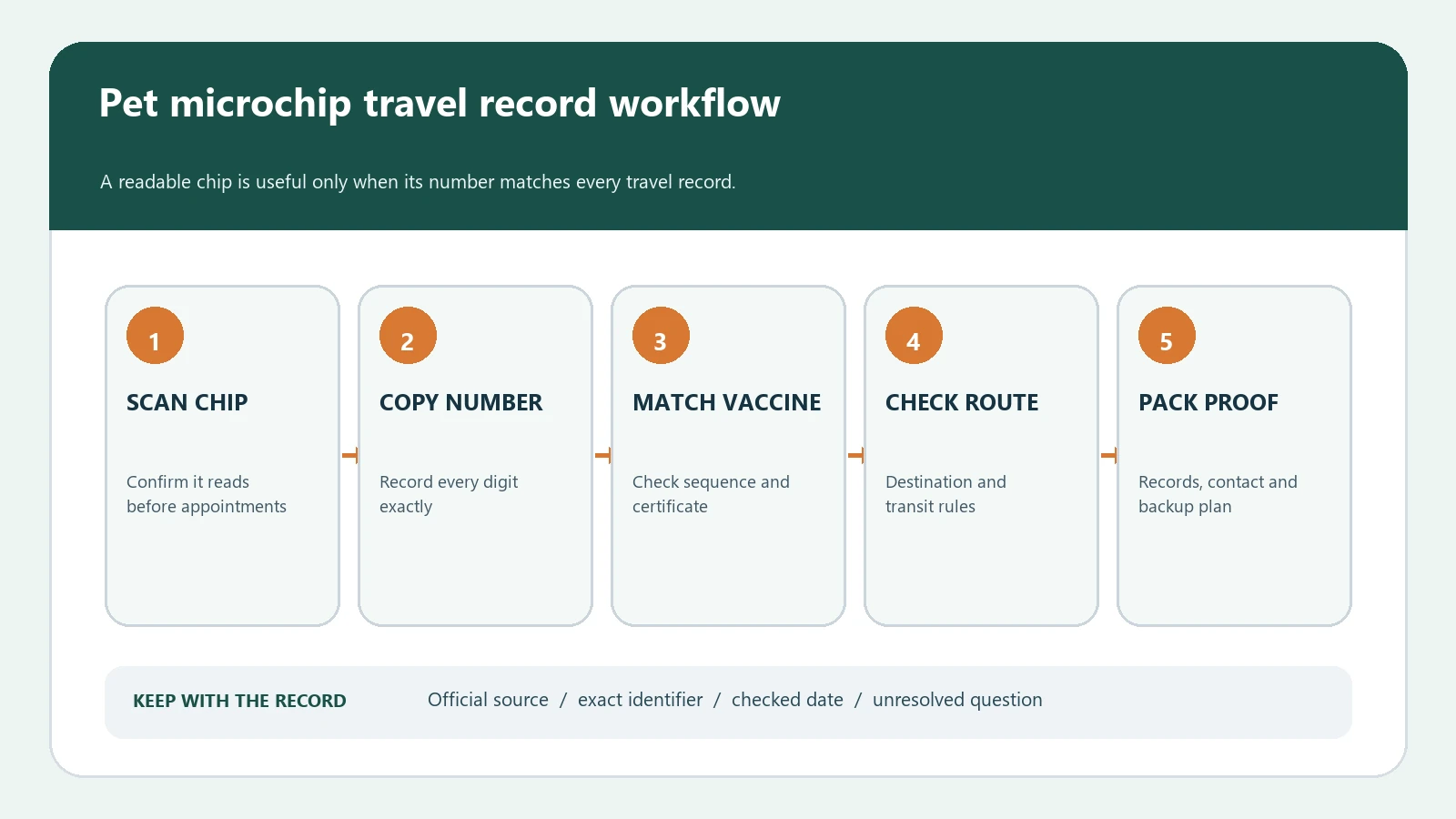
A pet microchip check before international travel should prove three separate things: a scanner reads the chip, the number on the scanner matches every travel document, and the chip-and-rabies sequence satisfies the destination’s current rule. A registry search can help identify a participating registry, but it does not prove that the chip works, that contact details are current, or that a country will admit the animal. Ask a veterinarian to scan the pet, copy the complete number from the display, and compare it character by character with the rabies certificate, laboratory record, import permit, and health certificate.
International requirements are route-specific. The USDA APHIS pet travel process tells U.S. travelers to select the destination and check its current requirements because countries can require different chips, vaccinations, tests, treatments, and certificates. The European Union pet travel guidance and Great Britain microchip guidance illustrate why the order of identification and rabies vaccination can matter. This page is a verification workflow, not veterinary advice or an entry guarantee.
One number, three different checks
Owners often say that a pet is chipped when they mean only that a chip was implanted years ago. Travel preparation asks more precise questions. Is a chip physically readable today? Is the displayed number the same number written on the official records? Does that identifier meet the destination’s technical and timing rules? Treating these as separate checks prevents a successful registry lookup from masking a failed scan or a document mismatch.
| Check | What counts as evidence | What it does not establish |
|---|---|---|
| Readable chip | A veterinary scan produces a stable, complete number | Registration, ownership, or destination eligibility |
| Document match | The same number appears on each required certificate, test, permit, and application | That the dates and other document fields are valid |
| Registry route | A lookup identifies a registry that may hold a record | That the listed contact information is current or that the finder is the owner |
| Travel compliance | The destination authority’s current rule is satisfied for chip type, timing, species, route, and documents | Airline acceptance or permission to enter a transit country |
The AAHA Universal Pet Microchip Lookup Tool is useful for routing a found number to a participating registry. AAHA explains that the tool does not display owner details, change a registration, or act as a registry itself. It also is not a universal international database. For travel, save the registry result separately from the veterinary scan and government requirements so the evidence does not get blended into a claim the lookup cannot support.
Build a microchip evidence record before booking deadlines
Create one record for the animal and keep the number as text, not only as a photograph. A photo can be hard to read, crop a digit, or preserve glare from a scanner display. Ask the clinic to print or email the scan result when possible. Record who scanned the animal, the date, the device result, and any second chip. If the pet has two chips, never choose one silently; ask the veterinarian and destination authority how both must be reported.
| Evidence field | Record exactly | Quality control |
|---|---|---|
| Pet identity | Name, species, breed or description, sex, color, and date of birth if known | Match the same animal description across documents |
| Microchip number | Every displayed digit with no spaces added | Read it aloud and compare it twice against the clinic record |
| Scan event | Date, clinic, person or veterinarian, and whether the result was stable | Use a recent pre-travel scan rather than relying only on implantation history |
| Chip standard | Manufacturer or clinic statement about ISO compatibility when required | Do not infer the standard from number length alone |
| Rabies record | Vaccine date, product, lot, validity dates, and microchip number shown | Check whether identification had to occur before or at vaccination |
| Other records | Titer result, import permit, health certificate, endorsement, and transit paperwork | Search every page and attachment for a mistyped or missing number |
| Checked sources | Destination authority URL, USDA route page, airline rule, and dates reviewed | Recheck near departure because rules and forms can change |
This evidence record complements the site’s pet travel documents checklist. Use it early enough that a veterinarian can investigate a non-reading chip or conflicting record without compressing a destination’s waiting periods. Do not implant, remove, or replace a chip based on a web article; those choices require a veterinarian and the destination’s official instructions.
Scan, copy, and compare the number step by step
- Schedule a veterinary scan before the final health-certificate appointment. Tell the clinic which countries the pet will enter or transit and whether the trip is a return journey.
- Ask the clinic to scan the animal methodically and confirm that the displayed number remains the same on repeat reads. A quick flash of a number is not a good transcription record.
- Copy the result exactly. Do not add a leading zero, drop a repeated digit, or convert the number to scientific notation in a spreadsheet.
- Place the scanner result beside the implantation record and rabies certificate. Compare from left to right, then compare again from right to left to catch transposed digits.
- Search every travel form for the identifier, including laboratory reports and import applications. Highlight a blank field rather than assuming an agency will connect records by the pet’s name.
- If a registry search is useful, enter the number into the official lookup and contact the identified registry directly. Update contact information through that registry, not through a travel blog or intermediary.
- Save a dated discrepancy list. A veterinarian or government authority should resolve each discrepancy before the certificate is issued or endorsed.
A useful final comparison is literal, not approximate. A certificate containing fourteen of fifteen correct digits does not identify the same electronic number. A pet name that matches does not cure the error. If an original record is wrong, ask the issuing clinic, laboratory, or authority about its correction procedure; do not edit a PDF or write over an official certificate yourself.
Why implantation and rabies dates must be read as a sequence
Some destinations connect the validity of a rabies vaccination to when the animal was identified. Great Britain tells travelers that a pet must be microchipped before, or at the same time as, its rabies vaccination and that the microchip number must be placed on the pet’s vaccination record. EU guidance likewise ties identification to the supporting health record. The practical lesson is not that one sequence applies everywhere; it is that the destination’s sequence must be checked before relying on an older vaccine.
| Timeline finding | Do next | Do not assume |
|---|---|---|
| Chip date is before rabies date | Confirm the chip number is on the vaccination record and the vaccine remains valid for the route | The waiting period, titer, or certificate requirements are automatically satisfied |
| Chip and rabies occurred the same day | Ask the veterinarian to document the order and check the destination’s wording | A shared calendar date proves the required sequence |
| Rabies date is before chip date | Show the records to an accredited veterinarian and check the destination authority’s remedy | The old vaccination will be accepted because it is still medically current |
| Implant date is unknown | Collect clinic records and ask what reading or documentation date the official form permits | A registry enrollment date is the implantation date |
| Two chips are present | Record both numbers and ask how each must appear on certificates | The newer or ISO-compatible chip can silently replace the older identifier |
The dates should also be compared with the rabies vaccination travel timeline and the international pet health certificate guide. A veterinarian may need to repeat a vaccination or document both chips under a destination’s rules. That decision belongs in the official route workflow, not in a generic registry lookup.
When the scanner cannot read the chip
A failed first scan is a problem to investigate, not immediate proof that the chip has disappeared. Ask the veterinary team to follow its normal scanning protocol, check the scanner, and scan a wider area. Bring any original chip documentation and tell the clinic if more than one identifier may exist. If the chip remains unreadable, ask the veterinarian to document the event and obtain destination-specific instructions before changing the animal’s records or identification.
| Problem | Evidence-preserving response | Authority needed |
|---|---|---|
| No number appears | Repeat the veterinary scan, keep the prior chip record, and record the failed-scan date | Veterinarian plus destination animal-health authority |
| Number differs from certificate | Photograph or print the scanner result and isolate every document with the other number | Original issuer, accredited veterinarian, and endorsing authority when applicable |
| Non-ISO chip is reported | Confirm compatibility with the manufacturer and read the destination’s scanner or second-chip rule | Destination authority; veterinarian for any clinical action |
| Registry returns no result | Contact the implanter or manufacturer and retain proof of the lookup | Registry or manufacturer; a no-result page is not a travel refusal |
| Contact data are old | Update the record with the registry that actually holds it | Registry account holder under its identity-verification process |
Non-ISO does not mean the same thing on every route. Some authorities may allow travel with a compatible reader; some may require another solution; forms may need both identifiers. Confirm the live destination page and get written guidance when the published rule does not fit the facts. Keep the question specific: chip type, number, implant or reading date, rabies date, species, origin, destination, transit countries, and arrival date.
Destination, transit, return, and airline checks are separate
The destination country sets entry requirements, but it may not be the only government involved. A transit country can impose animal movement conditions even when the owner does not plan to leave the airport. A return to the United States has its own current import rules. Airlines can add booking, carrier, temperature, breed, check-in, or document conditions without replacing government requirements. Build four rows in the trip plan rather than labeling everything destination rules.
- Destination: official animal-health or agriculture authority, species, travel purpose, arrival location, and current certificate route.
- Transit: each intermediate country and whether the pet changes aircraft, terminal, carrier, custody, or clearance area.
- Return: the rules in effect for the animal’s later return, including any country-risk classification or documentation created during the trip.
- Carrier: operating airline, codeshare partner, cabin or cargo route, advance reservation, check-in desk, and documents requested by the carrier.
Start at the USDA destination selector and retain the foreign authority link it provides. Then use the USDA APHIS pet travel check to organize the U.S. export path. A message from an airline agent can be useful evidence of the carrier’s instruction, but it should not be presented as a government waiver. Record the operating flight as well as the marketed flight because a codeshare can change who handles the animal.
Create a travel-day microchip file
Carry the original documents required by the route and a working set of copies in the order an official is likely to review them. Put a one-page cover sheet on top with the pet description, chip number, scan date, rabies date, certificate number, and emergency contacts. This sheet is an index, not a substitute for the originals. Avoid displaying the full chip number publicly in social posts, luggage photographs, or a shared booking screenshot.
| File section | Place inside | Final comparison |
|---|---|---|
| Identity | Recent scan record, implantation record, and second-chip note if applicable | Every digit agrees with the cover sheet |
| Vaccination and tests | Rabies certificate and destination-required laboratory results | Chip number and event dates agree with the official timeline |
| Government permission | Health certificate, endorsement, import permit, pre-notification, or official reply | Correct animal, traveler, route, dates, and ports |
| Transport | Airline acceptance, booking reference, cargo documents, and carrier instructions | Operating carrier and flight details are current |
| Recovery | Registry name, direct contact route, veterinarian, and emergency contact | Registry contact data were reviewed without treating registration as entry clearance |
Pet microchip travel questions
Can I check a pet microchip online?
You can enter a number in a legitimate lookup such as AAHA’s tool to identify a participating registry, but an online search cannot scan the animal. It may not cover every registry or country, and it does not prove current ownership or travel compliance. A veterinary scan and a document-by-document comparison are still needed.
Is a 15-digit chip automatically ISO compliant?
No safe travel decision should be based on length alone. Official guidance often describes ISO-compliant chips as 15 digits, but compatibility should be confirmed through the veterinarian or manufacturer and checked against the destination’s rule. If the chip is not compatible, ask the destination authority what reader or additional identification it accepts.
What if the certificate has one wrong digit?
Treat it as a mismatch. Contact the veterinarian or other issuing authority immediately and follow its correction process. Do not alter an official certificate yourself. If an endorsement or permit has already been issued, ask the responsible authority whether it must be replaced, corrected, or re-endorsed.
Does a registered chip guarantee entry?
No. Registration is primarily a recovery contact function. Entry can depend on the chip standard and timing, rabies vaccination, tests, treatments, permits, certificates, endorsement, route, species, and current government rules. Airlines can also impose separate transport conditions.
Pet-entry rules, forms, airline procedures, and official links can change. Verify the destination, transit, return, and operating-carrier requirements for the actual itinerary. Last reviewed August 6, 2026.