A pet travel health certificate is a route-specific document issued after a veterinarian examines the animal and verifies the vaccinations, tests, treatments, and identity required by the destination. You need one only when the destination, transit authority, airline, or other responsible authority requires it. The accepted form, issuer, signature date, government endorsement, and paper or digital format can all vary.
This guide was checked on July 23, 2026. It focuses on pets leaving the United States and also shows which checks apply more broadly. Country, state, airline, and animal-health rules can change. Reopen the official pages for the exact route before every trip.
Start with the route, not the certificate name
“Health certificate” is a category, not one universal form. USDA APHIS states that each country sets its own requirements based on the type of animal traveling. The same pet may need a different certificate for a different destination, a later trip, a commercial movement, or a return journey.
Write a route record before scheduling the final veterinary examination:
- origin country and state or territory;
- destination country and arrival airport or border;
- every transit country and whether the pet clears customs there;
- animal species, breed, age, and travel purpose;
- cabin, checked baggage, manifest cargo, or ground movement;
- airline and operating carrier for each segment;
- departure, connection, and arrival dates;
- whether the pet will return to the origin country.
Use that record when reading official requirements. A page for dogs arriving from one origin is not evidence for a cat, another origin, or a pet that enters through a different country first.
What a pet travel health certificate actually proves
An accepted certificate normally connects a specific animal to a specific movement. It may document a physical examination, microchip or other identification, vaccinations, laboratory results, parasite treatments, and compliance statements required by the destination. The veterinarian completes, signs, and dates the approved form after verifying those facts.
The certificate does not replace every other document. A route may also require an import permit, rabies certificate, laboratory report, vaccination record, owner declaration, advance notification, government endorsement, airline booking approval, or customs paperwork. Treat the certificate as one controlled item in a document set.
It is also not an admission guarantee. Border officials and carriers can inspect the pet and documents, and they apply the rules in force for the route and arrival date.
Separate the government certificate from airline paperwork
A clinic wellness note, an airline fit-to-fly statement, and a destination-country export certificate can serve different purposes. A document accepted by the airline at check-in may not satisfy the border authority. A government certificate accepted at the border may not answer the carrier’s booking, crate, temperature, breed, or recent-examination rules.
The FAA tells U.S. travelers to contact the airline for its specific pet policies and notes that an airline may require a recently issued health certificate. Ask the operating carrier, not only the ticket seller, for the exact document name, issue window, original or copy rule, and whether a separate form is used for cabin and cargo travel.
- Destination authority: controls entry health requirements.
- Export authority: controls issuance or endorsement needed before departure.
- Transit authority: may apply entry or transfer rules during the connection.
- Airline: controls acceptance for carriage and operational restrictions.
- Return authority: controls re-entry after the trip.
Build the date chain before booking the final exam
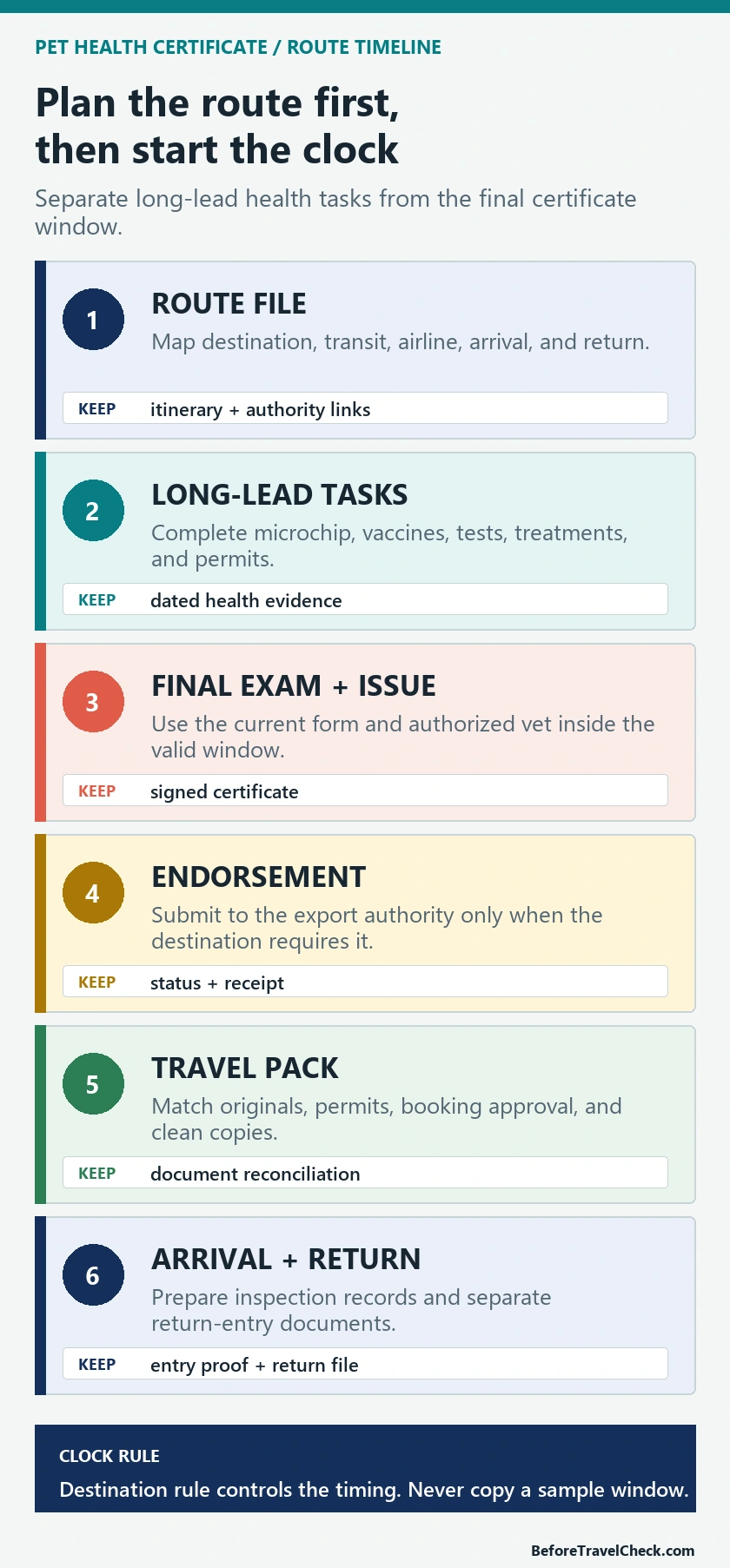
Begin with the planned arrival date and work backward. Long-lead items come first: microchipping, initial vaccination, booster rules, laboratory tests, waiting periods, permits, and reservations. The final examination and certificate signature usually belong near the end because the destination may accept the certificate only for a limited period.
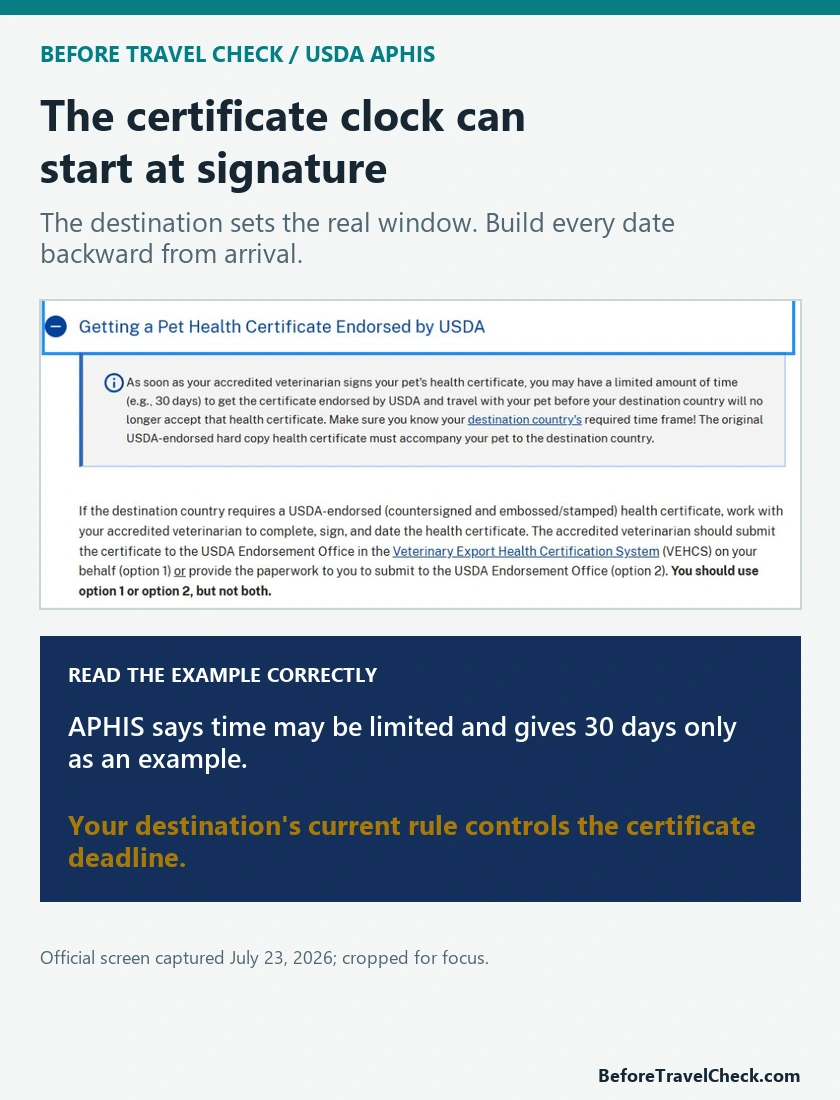
USDA APHIS warns that after an accredited veterinarian signs a certificate, the traveler may have only a limited amount of time to obtain USDA endorsement and travel. Its process page gives 30 days as an example, not a universal rule, and tells travelers to use the destination country’s required time frame.
- Mark the arrival date and local arrival time.
- Add every permit, vaccination, test, and treatment deadline.
- Add minimum waiting periods and maximum validity periods.
- Reserve time for the veterinarian to review the current form.
- Place the final exam and signature inside the accepted window.
- Add endorsement processing and delivery time when required.
- Leave time to correct a rejected or incomplete submission.
- Recheck airline timing, which may be different from the government window.
Do not choose the final appointment by counting from departure alone. Some rules are measured from vaccination, sampling, treatment, certificate issue, endorsement, arrival, or customs clearance.
Use the U.S. export process in the right order
For a pet leaving the United States, start with USDA APHIS Pet Travel and select the destination. APHIS recommends contacting a USDA-accredited veterinarian as soon as you decide to travel so the veterinarian can help identify required vaccinations, tests, treatments, and paperwork.
- Open the current APHIS destination page for the animal and route.
- Save the form name, version, instructions, and last-modified date.
- Confirm whether the destination requires a USDA-accredited veterinarian and APHIS endorsement.
- Complete the microchip, vaccination, testing, treatment, and permit prerequisites in order.
- Have the accredited veterinarian examine the pet and issue the current destination-specific certificate inside its time window.
- Submit the certificate and required supporting records for USDA endorsement when the destination requires it.
- Complete any allowed post-endorsement treatment, consulate approval, or advance notification.
- Carry the accepted originals or printed digitally endorsed documents and the supporting records required for the journey.
If the destination is not listed, follow APHIS guidance for unknown requirements and obtain written instructions from the responsible destination authority. Do not substitute a generic form because it looks familiar.
Make every identity field match
Small inconsistencies can delay endorsement or inspection. Compare the certificate against the microchip record, vaccination certificate, laboratory report, permit, booking, and owner documents before submission.
- microchip number, implantation or reading date, and chip location when requested;
- animal name, species, breed, sex, color, date of birth or age;
- owner or exporter name and address;
- destination and consignee information;
- vaccine product, manufacturer, batch or lot number, administration date, and validity;
- laboratory name, sample date, test method, and result;
- treatment product, dose, date, and time;
- travel date, certificate date, veterinarian signature, and endorsement.
Use the readable microchip number documented on the official records. Do not silently correct a number on one document while leaving the others unchanged. Ask the accredited veterinarian how the authority wants a correction recorded.
Submit for USDA endorsement only when required
For international export certificates that require USDA endorsement, APHIS says the issuing veterinarian must be USDA-accredited in the state where the veterinarian practices. The veterinarian issues the certificate; APHIS reviews and endorses it when the destination requires that government step.
The APHIS process describes two submission routes: the accredited veterinarian can submit through the Veterinary Export Health Certification System, or the signed paperwork can be shipped to the USDA Endorsement Office. Use the route allowed for the destination and do not create duplicate submissions through both routes.
A submission can require the international health certificate, vaccination certificates, laboratory results, an import permit, payment, and a prepaid express shipping label when a hard copy must be returned. Incomplete or inaccurate records can delay endorsement while the veterinarian or owner corrects the problem.
Carry the version the destination will accept
Do not assume a phone photo or PDF is accepted at the border. APHIS tells travelers to check whether the destination accepts a digitally endorsed certificate and describes routes where an endorsed hard copy must accompany the pet. The destination page and the certificate instructions control.
- Confirm whether a wet-signed, embossed, digitally endorsed, or printed certificate is accepted.
- Carry the original vaccination, test, and permit records when required.
- Keep clean copies apart from the originals.
- Make the microchip number and owner details easy to find.
- Store the airline approval and reservation with the government documents.
- Do not laminate, alter, or annotate an official certificate unless instructed.
Check the papers immediately after they are returned. A missing page, unreadable stamp, wrong destination, or mismatched date is easier to fix before travel day.
Run one final document reconciliation
At your internal travel lock date, place the certificate beside the route record and every supporting document. Read the animal identity, owner, destination, travel date, certificate issue date, endorsement, permit number, and airline approval aloud from the files rather than relying on memory. Confirm that the required original or printed endorsed copy is physically in the travel folder and that clean backup copies are available offline.
Save the telephone number and email for the accredited veterinarian, airline pet desk, and relevant government office with the documents. Record any advance-notification confirmation or inspection appointment. This final check cannot repair a missed waiting period, but it can catch a swapped pet record, an incomplete return package, or a certificate left at home while there is still time to act.
Check transit, airline, and return rules separately
A certificate for the final destination may not answer a transit country’s rules. Determine whether the pet remains airside, changes airports, travels as cargo, or clears customs during the connection. Ask the competent authority or carrier when the published rule does not cover the itinerary.
For a dog returning to the United States, check the current CDC dog import requirements before departure. CDC states that the requirements depend on where the dog was vaccinated and which countries it has been in during the six months before U.S. entry. The current CDC Dog Import Form receipt is a separate return document.
For travel between U.S. states or territories, APHIS does not endorse interstate pet health certificates. Check the destination state or territory and the airline. International export steps should not be copied onto a domestic trip.
Stop and verify when the form or timing is unclear
- The destination page offers more than one certificate and the choice is unclear.
- The animal, origin, purpose, or transit route does not match the published example.
- The veterinarian is not sure whether USDA accreditation or endorsement is required.
- A vaccination, test, or treatment date falls outside the stated sequence.
- The airline requests a different certificate or issue window.
- The destination will not clearly accept a digital endorsement or printed copy.
- The pet will return through a country with different entry requirements.
Pause before the certificate is issued. Recheck the current government page and ask the accredited veterinarian or responsible government office. A wrong form can consume the narrow period in which the correct certificate must be signed and endorsed.
Questions pet owners ask
Is a regular veterinary letter enough for international pet travel?
Only if the destination and carrier explicitly accept that document. Many routes require a destination-specific certificate issued by an authorized or accredited veterinarian and sometimes endorsed by a government authority.
Does one pet health certificate work for every country?
No. USDA APHIS states that there is no single standard certificate or set of requirements for all countries. Use the current form for the animal, origin, destination, purpose, and travel date.
When should I schedule the veterinarian?
Contact the veterinarian early for planning, but schedule the final examination only after every vaccination, test, treatment, issue, endorsement, and arrival window has been mapped backward from the trip.
Does a U.S. domestic trip need USDA endorsement?
No. APHIS does not endorse certificates for movement between U.S. states or territories. Check the destination state or territory and the airline for their own requirements.
Can the airline require a different health certificate?
Yes. Airline carriage rules are separate from border-entry rules. Ask for the exact carrier form and timing, then keep it distinct from the destination-country certificate.
Official sources and related guides
For U.S. departures, use the USDA APHIS Pet Travel Process Overview, the pet travel FAQ, the guide to finding a USDA-accredited veterinarian, and the accredited-veterinarian responsibilities. Use the FAA Flying with Pets page for the airline-policy distinction and the CDC Dog Import Form instructions for current U.S. return paperwork.
For the endorsement decision, read APHIS Endorsed Health Certificate. Use the Pet Travel Checklist Before You Fly to coordinate documents with the booking, and compare document roles in Pet Passport vs Health Certificate.