An airline pet policy must be checked for the exact operating carrier, flight, aircraft, travel date, animal, and transport method. A passenger ticket does not reserve space for a pet, and a carrier sold as “airline approved” does not guarantee acceptance. Get the pet booking confirmed, then verify eligibility, carrier limits, fees, documents, airport handling, and change rules before the itinerary becomes expensive to alter.
This checklist was reviewed on July 23, 2026. It uses U.S. Department of Transportation, FAA, TSA, USDA APHIS, and IATA guidance, but the airline’s current page and written confirmation control its own service. Destination, transit, and return-entry rules remain separate government checks.
Lock the itinerary before opening the policy
Airline pet rules are attached to a particular movement, not just an airline name. Start with a route record that identifies every segment. A rule for a nonstop domestic flight may not apply to an international connection, a partner-operated flight, or an animal tendered at a cargo facility.
- travel date and local departure and arrival times;
- flight number and booking class for each segment;
- marketing airline and the airline named after “operated by”;
- aircraft type when the booking shows it;
- origin, connection, and destination airports;
- cabin, accompanied hold, checked baggage, or manifest cargo;
- pet species, breed or mix, age, weight, and number of animals;
- carrier exterior dimensions and combined pet-and-carrier weight.
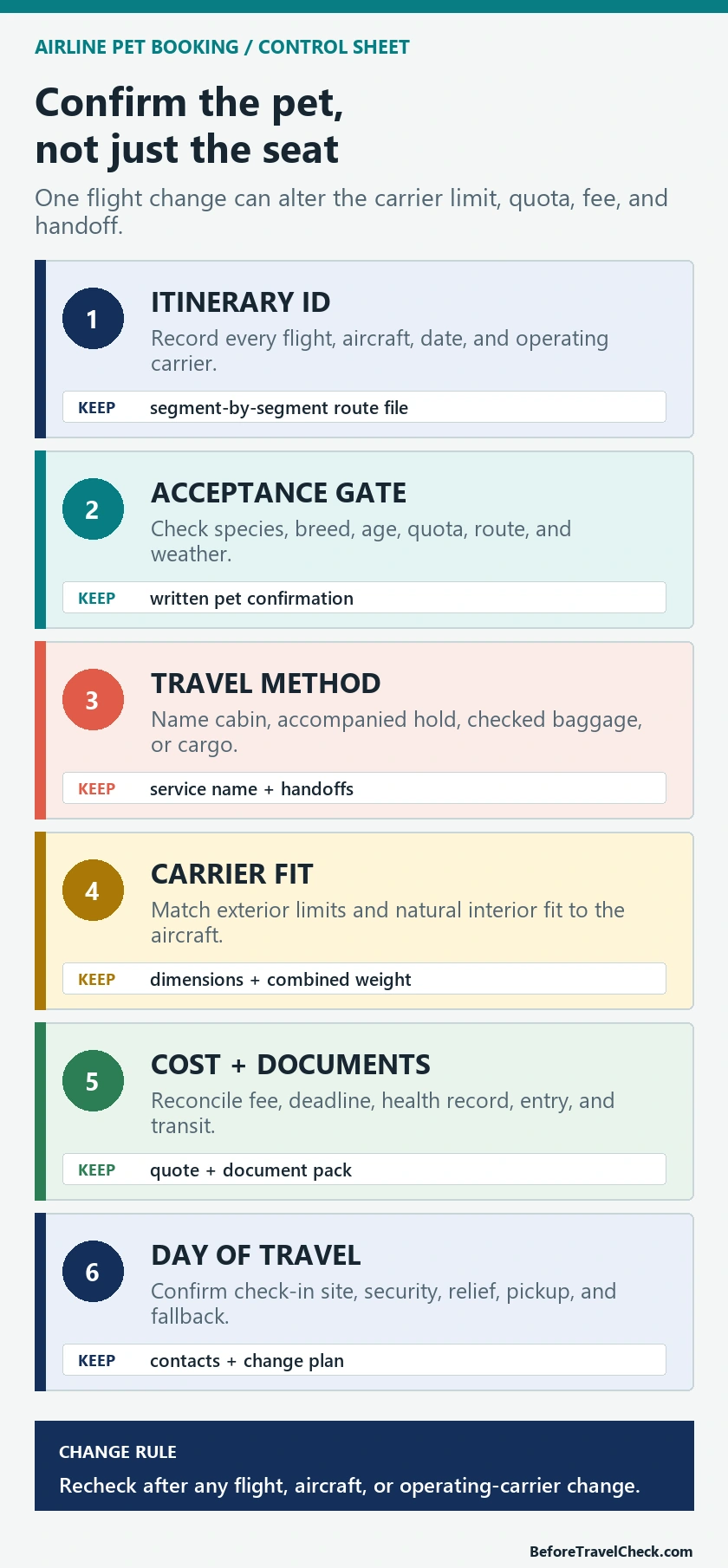
Use the airline website to find the current pet page, optional-services or fee page, restricted-route notices, and cargo instructions. Save the page date or a screenshot with the itinerary. A search-result snippet or retailer description is not enough evidence for check-in.
Confirm that the airline will accept this pet
The U.S. Department of Transportation’s Flying with a Pet page says pet policies vary among airlines. It lists restrictions that may involve species, breed, size, weight, age, behavior, weather, seating, and kennel type. Treat each item as an acceptance gate, not as a detail to resolve at the airport.
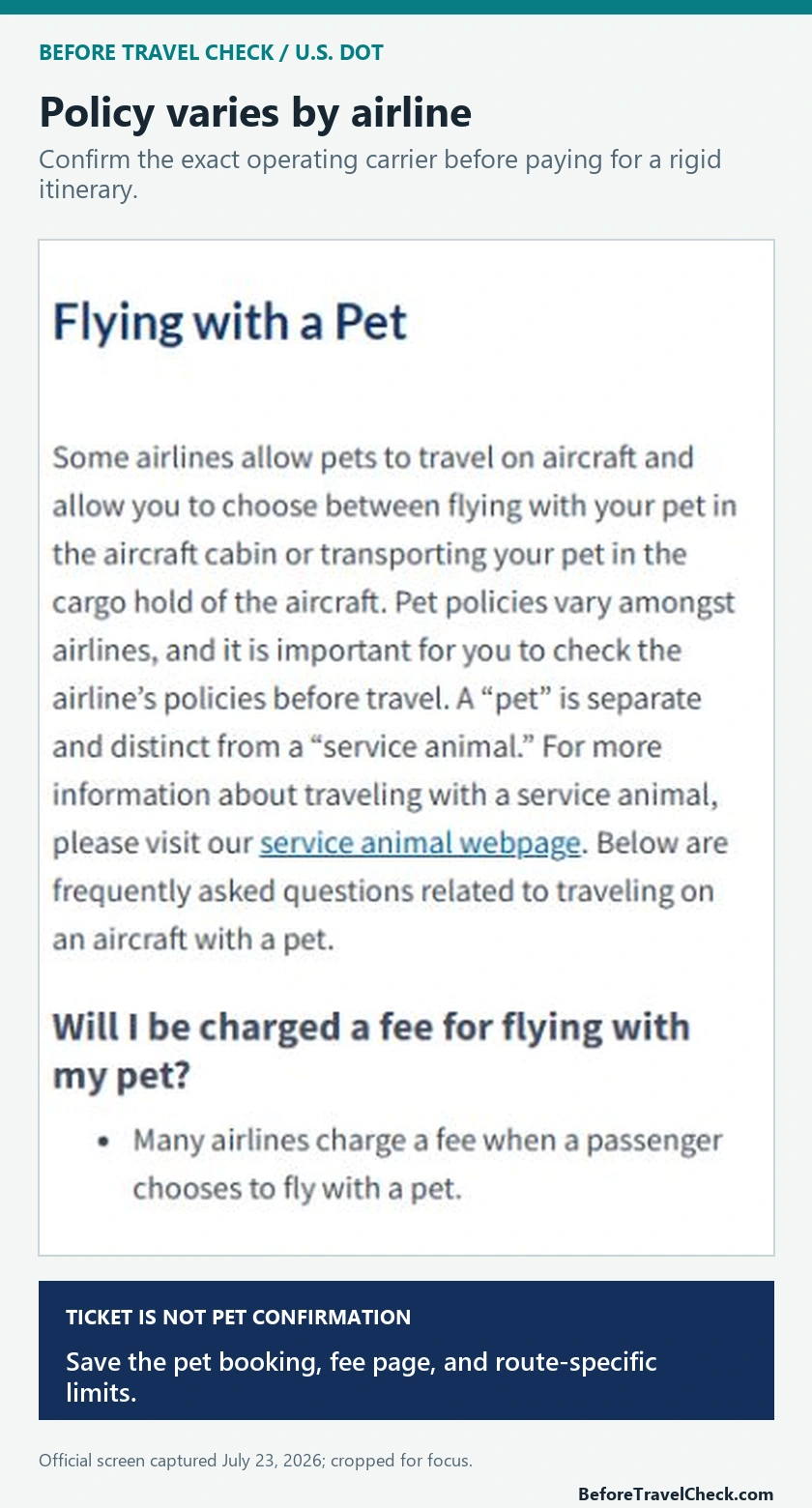
- Does the airline carry pets on this route and date?
- Is the species accepted in the selected cabin or travel method?
- Does a short-nosed breed, age, health, or behavior restriction apply?
- Is there a total pet limit for the cabin or flight?
- Are pets excluded from the booked cabin, fare type, or seat area?
- Does a seasonal heat, cold, or destination embargo block hold or cargo travel?
- Can one passenger accompany the planned number of carriers or animals?
This page concerns pets. A trained service dog is handled under a different legal and documentation framework. Travelers who need that process should use the DOT service-animal guidance rather than trying to fit a service animal into a pet booking.
Treat cabin, checked baggage, and cargo as different services
An airline may offer one method, several methods, or no pet transport on a route. Do not use the words interchangeably when asking for approval.
- Cabin: the pet normally remains inside a carrier stowed under the seat, subject to the airline’s pet quota, carrier limit, seating rule, and fee.
- Accompanied hold or checked baggage: the animal travels in a temperature-controlled aircraft compartment on the passenger’s journey when the airline offers that service.
- Manifest cargo: the animal is booked under cargo procedures, with separate acceptance, facility, cut-off, handoff, and collection requirements.
A cabin approval does not prove that the same carrier works for cargo. Cargo acceptance does not promise that a pet can connect between airlines. Ask where the animal is delivered, who handles a transfer, when the receiving facility is open, and what happens if the flight is delayed or diverted.
Verify the operating carrier on every flight
A ticket can display one airline’s code while another airline operates the aircraft. Pet acceptance, under-seat space, quotas, and cargo handling may follow the operating carrier. Check every segment, including the return trip, and do not assume that one airline can confirm a partner’s pet space.
- Open the detailed itinerary and record each “operated by” airline.
- Read that operating carrier’s pet policy for the exact travel method.
- Ask whether the ticketing carrier can request pet space or whether you must contact the operator.
- Confirm how a connection between carriers is handled.
- Obtain a pet reservation or service confirmation for every applicable segment.
- Save the confirmation number, date, channel, and the name or identifier of the agent when available.
If an agent says the pet is “noted” in the booking, ask whether that means confirmed space or only a service request. The useful record is one that shows the pet service is accepted for the exact flight.
Measure the pet and carrier against the booked aircraft
The FAA Flying with Pets page explains that an in-cabin pet container is carry-on baggage. It must fit beneath the seat without blocking the path to the aisle and remain properly stowed during surface movement, takeoff, and landing. Airlines can add their own limits and procedures.
Measure the carrier after it is assembled, with rigid frames, wheels, pockets, mats, and handles in their travel position. Record length, width, height, and empty weight. Then weigh the pet and check whether the airline limits the carrier alone, the combined weight, or both. If a policy gives different limits by aircraft or cabin, use the booked aircraft’s rule and ask what applies after an equipment change.
Interior fit matters as much as the exterior number. IATA’s Traveler’s Pet Corner tells travelers to choose a container that lets the animal turn normally while standing, stand and sit erect, and lie in a natural position. Test that fit with the door closed while the purchase can still be returned. For a more detailed measurement check, use the airline-approved pet carrier guide; for hold or cargo construction, see the pet crate guide.
Reserve the pet before paying for a rigid itinerary
Pet capacity can be smaller than passenger capacity. IATA advises travelers to contact the selected airline and confirm that it accepts the pet on the preferred day and flight; some airlines restrict the number of animals on a flight. A seat being available online does not mean pet space remains.
- Find an itinerary that meets destination and transit rules.
- Check pet eligibility and carrier limits for each operating carrier.
- Ask the airline how to hold or book the passenger itinerary while pet space is requested.
- Receive the pet-service confirmation before the fare becomes nonrefundable when possible.
- Check the assigned seat against pet seating restrictions.
- Verify the payment deadline and whether the pet fee is paid now or at the airport.
- Open the reservation again and confirm the pet service appears correctly.
Keep a fallback route that avoids an unsupported connection or seasonal embargo. The cheapest passenger fare can become the most expensive option if the pet cannot travel on it.
Price the whole trip, not only the pet fee
DOT notes that airlines may use a separate pet fee, a baggage charge, or a baggage-allowance rule. For airlines marketing to U.S. consumers, optional-service pages are the place to look for disclosed charges. Read the conditions beside the amount: direction, segment, connection, refund, change, and payment location can matter.
- pet fee for each direction or segment;
- effect on cabin or checked baggage allowance;
- cargo rate, terminal handling, and storage charges;
- carrier or crate purchase and required accessories;
- veterinary examination, tests, treatments, and certificates;
- government endorsement, permit, or inspection charges;
- ground transport to a cargo facility and collection at arrival;
- overnight care or rebooking if weather blocks transport;
- change and cancellation exposure for the passenger ticket and pet service.
Save the fee page and written quote. If the airline changes the aircraft or route, ask whether the pet service transfers automatically and whether a refusal or embargo makes the pet fee and passenger fare refundable.
Keep airline paperwork separate from border documents
An airline can require a recent health record even when a government authority does not require the same document. DOT gives a certified health record issued within 10 days of travel as an example used by some airlines; it is not a universal window. Ask the operating carrier for the exact document name, issuer, issue date, and whether a paper original is required.
International entry is a separate decision. Use USDA APHIS Pet Travel for U.S. export routes and the destination and transit authorities for their current requirements. A pet reservation does not replace an import permit, health certificate, vaccination proof, laboratory report, quarantine booking, or return-entry document. The pet travel health certificate guide explains how to build the document timeline.
Keep four records distinct: airline acceptance, veterinary records, government entry or export documents, and cargo or airport handoff paperwork. Compare the animal name, microchip number, owner, route, and dates across them before departure.
Rehearse the airport handoffs
Ask the airline where and when the pet must be presented. Cabin pets may use the passenger terminal, while cargo animals may be accepted at a separate facility with an earlier cut-off. Record the address, opening hours, contact number, required identification, and collection process at the destination.
For U.S. passenger checkpoints, the TSA pet screening guidance says the pet is removed from the carrier and the empty carrier goes through the X-ray machine. The traveler maintains control of the animal; TSA can visually or physically inspect the carrier. Use a secure harness or leash and ask for a private screening room if removing the animal in the open checkpoint creates an escape risk.
- arrive at the airline’s stated pet check-in or cargo acceptance time;
- carry the pet confirmation and document originals where they can be reached;
- know when the animal must enter or leave the carrier;
- locate pet relief areas before reaching the gate;
- keep a recent photo and destination contact with the travel file;
- confirm who receives the animal at every transfer and at arrival.
Recheck after any schedule or aircraft change
A schedule change can silently alter the operating carrier, aircraft, connection time, airport, or pet-handling window. Do not rely only on the passenger seat remaining confirmed.
- Compare every flight number and “operated by” line with the saved record.
- Recheck carrier dimensions and pet quota for the replacement aircraft.
- Confirm the pet service is still attached to each segment.
- Reopen heat, cold, breed, and route restrictions close to departure.
- Recalculate health-record and government-document validity against the new arrival time.
- Ask how a cancellation, diversion, or missed connection changes the pet handoff.
Run this check again 72 hours before departure and once more before leaving for the airport. Use the broader pet travel checklist to reconcile the booking, documents, carrier, and arrival plan.
Related official record checks
- Frontier Airlines Pet Policy: Cabin, Cargo, Carrier and Booking Check
- Spirit Airlines Pet Policy: Cabin, Cargo, Carrier and Booking Check
- Hawaiian Airlines Pet Policy: Cabin, Cargo, Carrier and Booking Check
- Allegiant Air Pet Policy: Cabin, Cargo, Carrier and Booking Check
- Sun Country Airlines Pet Policy: Cabin, Cargo, Carrier and Booking Check
- Porter Airlines Pet Policy: Cabin, Cargo, Carrier and Booking Check
- Aer Lingus Pet Policy: Cabin, Cargo, Carrier and Booking Check
- Iberia Pet Policy: Cabin, Cargo, Carrier and Booking Check
- TAP Air Portugal Pet Policy: Cabin, Cargo, Carrier and Booking Check
- SWISS Pet Policy: Cabin, Cargo, Carrier and Booking Check
- SAS Pet Policy: Cabin, Cargo, Carrier and Booking Check
- Finnair Pet Policy: Cabin, Cargo, Carrier and Booking Check
- Etihad Airways Pet Policy: Cabin, Cargo, Carrier and Booking Check
- Cathay Pacific Pet Policy: Cabin, Cargo, Carrier and Booking Check
- EVA Air Pet Policy: Cabin, Cargo, Carrier and Booking Check
- China Airlines Pet Policy: Cabin, Cargo, Carrier and Booking Check
- Qantas Pet Policy: Cabin, Cargo, Carrier and Booking Check
- Air New Zealand Pet Policy: Cabin, Cargo, Carrier and Booking Check
- Virgin Atlantic Pet Policy: Cabin, Cargo, Carrier and Booking Check
- Virgin Australia Pet Policy: Cabin, Cargo, Carrier and Booking Check
- LOT Polish Airlines Pet Policy: Cabin, Cargo, Carrier and Booking Check
- Air India Pet Policy: Cabin, Cargo, Carrier and Booking Check
- LATAM Airlines Pet Policy: Cabin, Cargo, Carrier and Booking Check
- Copa Airlines Pet Policy: Cabin, Cargo, Carrier and Booking Check
- Avianca Pet Policy: Cabin, Cargo, Carrier and Booking Check
- Aeromexico Pet Policy: Cabin, Cargo, Carrier and Booking Check
- Saudia Pet Policy: Cabin, Cargo, Carrier and Booking Check
- Royal Jordanian Pet Policy: Cabin, Cargo, Carrier and Booking Check
- Malaysia Airlines Pet Policy: Cabin, Cargo, Carrier and Booking Check
- Philippine Airlines Pet Policy: Cabin, Cargo, Carrier and Booking Check
- Thai Airways Pet Policy: Cabin, Cargo, Carrier and Booking Check
- Vietnam Airlines Pet Policy: Cabin, Cargo, Carrier and Booking Check
- Air Europa Pet Policy: Cabin, Cargo, Carrier and Booking Check
- Aegean Airlines Pet Policy: Cabin, Cargo, Carrier and Booking Check
- EgyptAir Pet Policy: Cabin, Cargo, Carrier and Booking Check
- Oman Air Pet Policy: Cabin, Cargo, Carrier and Booking Check
- Gulf Air Pet Policy: Cabin, Cargo, Carrier and Booking Check
- Kenya Airways Pet Policy: Cabin, Cargo, Carrier and Booking Check
- Ethiopian Airlines Pet Policy: Cabin, Cargo, Carrier and Booking Check
- Brussels Airlines Pet Policy: Cabin, Cargo, Carrier and Booking Check
- Condor Pet Policy: Cabin, Cargo, Carrier and Booking Check
- Icelandair Pet Policy: Cabin, Cargo, Carrier and Booking Check
- Austrian Airlines Pet Policy: Cabin, Cargo, Carrier and Booking Check
- ITA Airways Pet Policy: Cabin, Cargo, Carrier and Booking Check
- airBaltic Pet Policy: Cabin, Cargo, Carrier and Booking Check
Use the guide that matches the exact agency, jurisdiction, tool, product, program, or record type; verify the live official source before acting.
- USDA VEHCS Status Meanings: Submitted, Endorsed, Returned and Rejected
- Correcting a USDA-Endorsed Pet Health Certificate
- USDA Endorsement Return Shipping: Label, Tracking and Deadline
- USDA Pet Health Certificate Endorsement Fee Check
- Verify a USDA-Accredited Veterinarian's Category and Authority
- Pet Microchip and Rabies Order: Fixing a Vaccine Given Too Early
- ISO Pet Microchip Scanner Compatibility Before International Travel
- Rabies Titer Test Timeline: Sample Date, Lab Result and Waiting Period
- Pet Health Certificate Name Mismatch: Owner, Traveller and Consignee
- EU Animal Health Certificate Validity After Arrival
- Pet Transit Rules: When a Layover Country Becomes an Entry Country
- Codeshare Pet Booking: Which Airline's Animal Rule Controls
- Separate Tickets With a Pet: Recheck, Customs and Connection Time
- Pet Reservation Confirmation: SSR Code, Capacity and Payment Proof
- Pet as Cargo Versus Accompanied Baggage: Choosing the Legal Route
- Pet Air Waybill Tracking: Status Codes and Destination Handoff
- IATA CR82 Pet Crate Measurement: Length, Height and Door Clearance
- Pet Crate Ventilation, Door Hardware and Wheel Rules
- Brachycephalic Pet Flight Embargo: Breed, Route and Temperature Check
- Airline Pet Temperature Embargo: Forecast, Station and Rebooking Plan
Use the guide that matches the exact agency, jurisdiction, tool, product, program, or record type; verify the live official source before acting.
Questions travelers still ask
Does an airline-approved label guarantee acceptance?
No. The operating carrier decides whether the pet, route, travel method, carrier, and booking meet its current rules. Measure the actual product and obtain a pet reservation.
Is a pet included when I buy the passenger ticket?
Usually not automatically. Airlines can limit pet space and require a separate request, confirmation, and fee. Check that the service is confirmed on the exact flight.
Which under-seat carrier dimensions should I use?
Use the operating airline’s limit for the booked aircraft, cabin, and seat area. Ask which rule applies if the policy lists several sizes or the aircraft changes.
Can an airline refuse the pet at the airport?
Yes. A missing reservation, wrong carrier, ineligible animal, document problem, behavior concern, weather embargo, or route restriction can prevent acceptance. Written confirmation reduces uncertainty but does not excuse a failed day-of-travel condition.
Do I need a health certificate for every flight?
No universal rule applies. The airline, destination, transit authority, and return authority can each impose a different document and time window. Check all four.
Move from the general checklist to the operating airline’s actual route. For Air Canada, verify the aircraft-specific carrier limit. For Qatar Airways, decide whether the animal uses checked baggage, cargo, or a limited cabin exception.
Official sources and related guides
Use the DOT Flying with a Pet page for the range of airline restrictions and fee disclosures, the FAA cabin-container rules, the TSA checkpoint procedure, and IATA Traveling with Pets for airline-specific planning and animal fit. Reopen the operating carrier’s own pages for the final decision.
Before paying, cross-check the carrier measurement guide, the health-certificate timeline, and the full preflight checklist.