Check Pet Air Waybill Tracking: Status Codes and Destination Handoff against the current airline, destination and veterinary authority before travel. Keep the operating carrier, route, animal, document or crate identifier, fee and validity date together; one accepted document or booking step does not clear every travel gate.
The official record is the source of truth for this narrow lookup. Open IATA and USDA APHIS, confirm that the result belongs to Cargo event codes and consignee release are separate from passenger baggage tracking, and distinguish a displayed fact from an inference the system never makes.
Start with the authority that owns the record
Treat Pet Air Waybill Tracking as a source with boundaries, not a universal answer service. Its useful role in Cargo event codes and consignee release are separate from passenger baggage tracking is The reader wants to read air-waybill events and identify who controls the next handoff.. Read the system description, jurisdiction, and update language; then follow the matched row to its underlying document or detail page. A search-engine excerpt or third-party directory does not preserve those boundaries.
| Official source | Use it for | Save with the result |
|---|---|---|
| IATA | Start the lookup and identify the current public record | Input used, matched subject, record identifier, status, and displayed date |
| USDA APHIS | Read definitions, instructions, dates, and scope limitations | Authority name, page title, definition relied on, and review date |
The sources perform different jobs. One locates the subject, another explains Cabin, hold, cargo or refused transport route, and a linked file may establish Correction, rebooking or escalation route. For Pet Air Waybill Tracking: Status Codes and Destination Handoff, note beside each fact which page supplied it. That small source map prevents an old summary or private directory from inheriting authority it does not have.
Collect identifiers before opening the search form
Write the subject record before searching. At minimum capture Operating carrier and flight number, Origin, transit and destination countries, and Pet species, breed, weight and age. This makes alternate searches comparable and exposes a change in spelling or jurisdiction. A nearby address, related company, similar model, or shared name is not a match merely because it appears first.
| Input to collect | How to record it | Mistake to avoid |
|---|---|---|
| Operating carrier and flight number | Use the format requested by the official search form. | The field may be optional for search but necessary for confirmation. |
| Origin, transit and destination countries | Copy it from the original record; do not normalize it from memory. | The field may be optional for search but necessary for confirmation. |
| Pet species, breed, weight and age | Record the value before the lookup so search changes remain visible. | The field may be optional for search but necessary for confirmation. |
| Carrier or crate exterior dimensions and total weight | Record the value before the lookup so search changes remain visible. | Do not publish personal or sensitive identifiers in a shared note. |
| Microchip, vaccine, certificate and permit identifiers | Record the value before the lookup so search changes remain visible. | A close match can still belong to a different record. |
| Booking, veterinary, endorsement and travel dates | Copy it from the original record; do not normalize it from memory. | Missing punctuation or a unit can change the result set. |
A reproducible note does not need every private document. Retain the public search field, matched public identifier, and the values needed to distinguish the record; redact sensitive numbers and application materials. If Pet Air Waybill Tracking has several search modes, record the one used and whether a broader query produced unresolved candidates.
From search box to defensible record
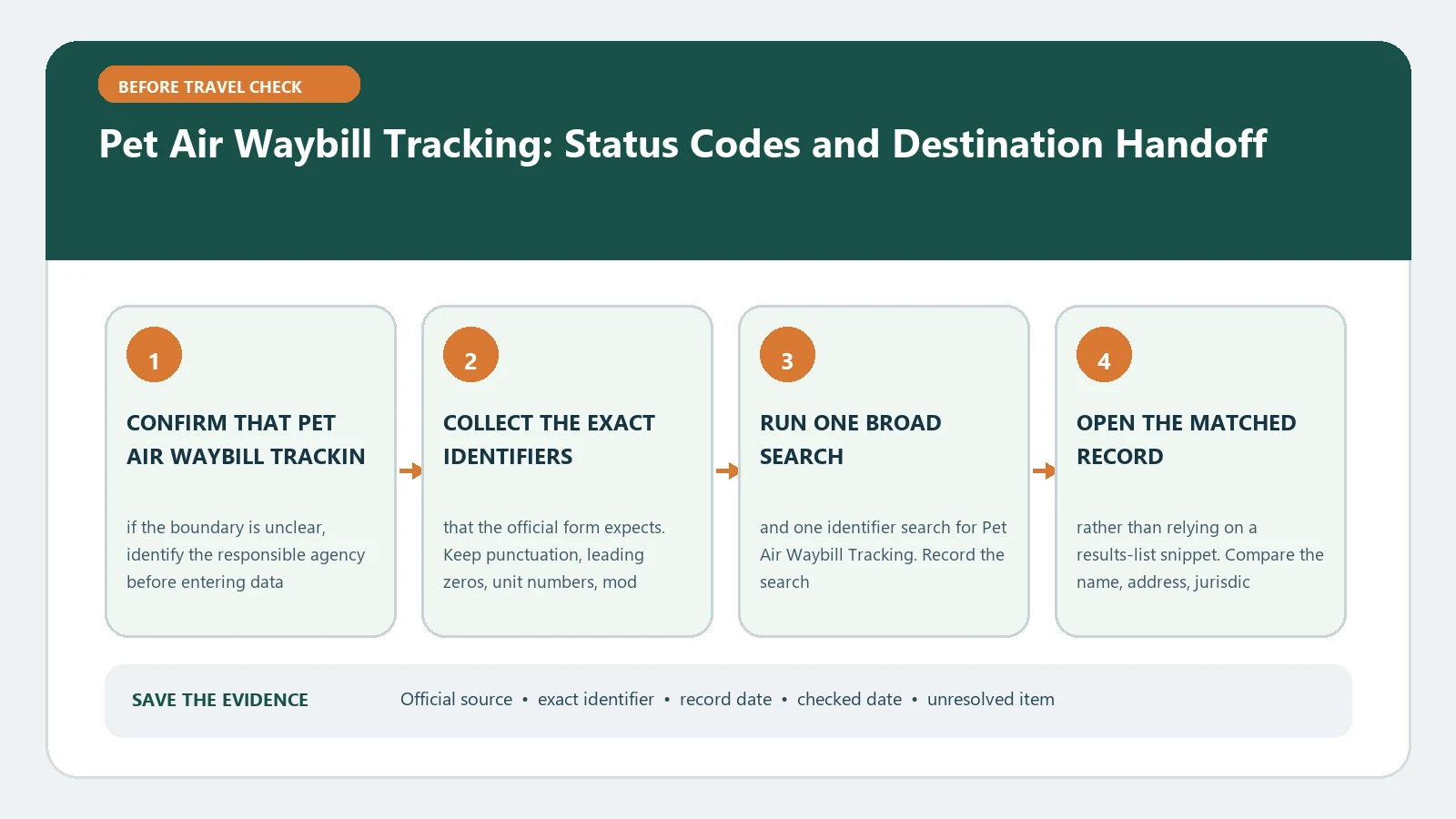
- Confirm that Pet Air Waybill Tracking is the official system for Cargo event codes and consignee release are separate from passenger baggage tracking; if the boundary is unclear, identify the responsible agency before entering data.
- Collect the exact identifiers that the official form expects. Keep punctuation, leading zeros, unit numbers, model suffixes, and date formats unchanged.
- Run one broad search and one identifier search for Pet Air Waybill Tracking. Record the search inputs so another reader can repeat the same check.
- Open the matched record rather than relying on a results-list snippet. Compare the name, address, jurisdiction, identifier, and date fields.
- Read status labels through the issuing authority's definitions. Save the effective or inspection date separately from the date you performed the lookup.
- Follow linked notices, ordinances, reports, maps, attachments, or case records needed to answer the narrow question.
- If a field is missing or conflicting, preserve the result and ask the listed authority a specific question instead of converting uncertainty into a conclusion.
The workflow creates an audit trail for Pet Air Waybill Tracking: who was searched, where, with which value, what matched, and what the authority said next. Keeping those steps in order reveals whether a later difference is an updated record or merely a different query.
Translate the result one field at a time
A status is a quoted field, not a general conclusion. For Pet Air Waybill Tracking: Status Codes and Destination Handoff, record the original wording, record type, jurisdiction, and date, then consult the source definition. The same everyday word can describe very different procedural stages across agencies and systems.
| Result field | Verification action | Interpretation limit |
|---|---|---|
| Cabin, hold, cargo or refused transport route | Open the detailed record or linked document before interpreting it. | Destination, transit, return, and airline requirements are separate checks. |
| Reservation, capacity and payment status | Compare it with the identifier and jurisdiction already confirmed. | Destination, transit, return, and airline requirements are separate checks. |
| Carrier or crate measurement and construction rule | Compare it with the identifier and jurisdiction already confirmed. | Policies and entry forms can change after a booking is made. |
| Document, endorsement or permit status | Transcribe the displayed wording and date exactly. | Policies and entry forms can change after a booking is made. |
| Fee, embargo, inspection or handoff requirement | Keep current and historical entries in separate rows. | A marketed flight and the operating carrier can apply different transport procedures. |
| Correction, rebooking or escalation route | Transcribe the displayed wording and date exactly. | Destination, transit, return, and airline requirements are separate checks. |
Before acting, align the date with the intended decision. A valid-looking result from Pet Air Waybill Tracking may precede a renewal, map revision, follow-up inspection, recall expansion, policy change, or filing. Record the displayed date, the relevant decision date, and today’s access date as separate facts.
Pet Air Waybill Tracking field crosswalk
This original crosswalk implements Pet Air Waybill Tracking: official evidence, deadline/status, interpretation and recovery table. It joins the official field to the reader’s matching input and a bounded interpretation. Copy live values into a separate working copy and place the record date beside every status that can change.
| Record row | Official field | Reader check | Interpretation |
|---|---|---|---|
| Identity | Cabin, hold, cargo or refused transport route | Operating carrier and flight number | Confirm that the returned record belongs to the intended subject. |
| Scope | Reservation, capacity and payment status | Origin, transit and destination countries | Keep the jurisdiction, date, and record type with the value. |
| Status | Carrier or crate measurement and construction rule | Pet species, breed, weight and age | Use the authority’s definition instead of a general dictionary meaning. |
| Next action | Document, endorsement or permit status | Carrier or crate exterior dimensions and total weight | Follow the linked notice, rule, report, map, or agency instruction. |
Turn the lookup into a reusable evidence record
The evidence card makes Pet Air Waybill Tracking: Status Codes and Destination Handoff independently repeatable. It preserves the target, authority, query, match, status, dates, and unresolved question. That is more useful to a reader than an isolated screenshot because every field has a source and can be checked again.
| Evidence field | What to enter | Why it matters |
|---|---|---|
| Target | Pet Air Waybill Tracking: Status Codes and Destination Handoff | Names the exact record or decision being checked |
| Official source | IATA | Preserves the issuing authority rather than a copied summary |
| Search input | Exact name, address, number, parcel, model, route, or other identifier used | Makes the result reproducible |
| Matched record | Displayed identifier, jurisdiction, and record type | Shows why the result belongs to the intended subject |
| Observed result | Status or field copied without expanding its meaning | Separates evidence from interpretation |
| Dates | Record date, effective date, and checked date in separate fields | Exposes stale or superseded information |
| Unresolved item | Specific missing field, conflict, or agency question | Prevents silence from becoming a false conclusion |
Downloadable records are useful for change tracking. Give the file a name containing the subject, record date, and checked date, while the evidence card retains the live link. Do not present an old capture as the current result when Cabin, hold, cargo or refused transport route can change.
Resolve missing, stale, or conflicting records
Treat a mismatch as a finding to resolve. Compare Operating carrier and flight number and Origin, transit and destination countries, check for a historical system, and follow linked corrections or case documents. Never choose the more favorable official result without explaining why it supersedes the other.
- Do not broaden the conclusion beyond A marketed flight and the operating carrier can apply different transport procedures.
- Do not broaden the conclusion beyond Destination, transit, return, and airline requirements are separate checks.
- Do not broaden the conclusion beyond Policies and entry forms can change after a booking is made.
- State the exact unresolved question and include the record identifier in a private agency inquiry.
- Recheck after an agency update, correction, inspection, filing, map revision, or policy effective date.
- Keep the earlier result when change history matters; label it superseded rather than silently replacing it.
Related instructions are available in airline pet policy checklist, pet travel checklist before you fly and pet travel health certificate. Link a reader onward only when the next page changes the record, authority, or decision being checked. The current page owns Pet Air Waybill Tracking; the official system owns the underlying fact.
Questions about Pet Air Waybill Tracking
Does an official search result prove the final outcome?
Not by itself. The result supports the narrow fact represented by Cabin, hold, cargo or refused transport route. It does not automatically establish approval, present condition, safety, ownership, eligibility, or compliance beyond the authority’s stated scope.
What should I do when no record appears?
Keep the no-result screen as limited evidence, verify the strongest second identifier, and search only another official system identified by the authority. Escalate the exact subject and query when the unresolved gap matters.
How often should the result be checked again?
There is no universal interval. Recheck when the governing date approaches, when new information is submitted, and before relying on Pet Air Waybill Tracking: Status Codes and Destination Handoff for money, safety, travel, property, or eligibility decisions.
Can I cite this guide instead of the agency?
Use this page to structure the work, but cite IATA and USDA APHIS for the fact. Include the record or document title, public identifier, relevant date, live URL, and access date so another reader can return to the evidence.
Official databases, policies, maps, notices, statuses, and links can change. Verify the live source for the actual person, property, product, business, route, or jurisdiction before acting. Last reviewed August 9, 2026.