A pet passport and a health certificate are not universal substitutes. The accepted document comes from the animal’s species, country of departure, destination, transit route, journey type, and travel date. An EU pet passport can work for an eligible journey within the European system, while a traveler entering the EU from a non-EU country normally follows the EU animal health certificate route. The United States does not issue pet passports for international travel.
Start by writing one route line: pet and species + origin + destination + every border crossed + owner travel timing + arrival date. Use that line to open the current destination-government instructions. Do not begin with the cover of a document, a veterinary clinic advertisement, an airline summary, or a form found in search results.
Reviewed July 22, 2026. Pet-entry rules and certificate models can change without notice. This guide explains a verification process; it does not replace instructions from the destination authority, export authority, an authorized veterinarian, or the carrier for a specific trip.
Passport and health certificate are not interchangeable
A pet passport is a continuing identification and health record issued under a system that recognizes it. A health certificate is usually issued for a particular movement and time window. Both may contain a microchip number, vaccination details, owner information, and veterinary entries, but similar fields do not make the documents interchangeable.
The USDA APHIS pet travel FAQ makes two boundaries clear for U.S. travelers: there is no one health certificate that works in every country, and the United States does not issue pet passports for international travel. APHIS instead directs travelers to the destination’s requirements and any transit-country requirements.
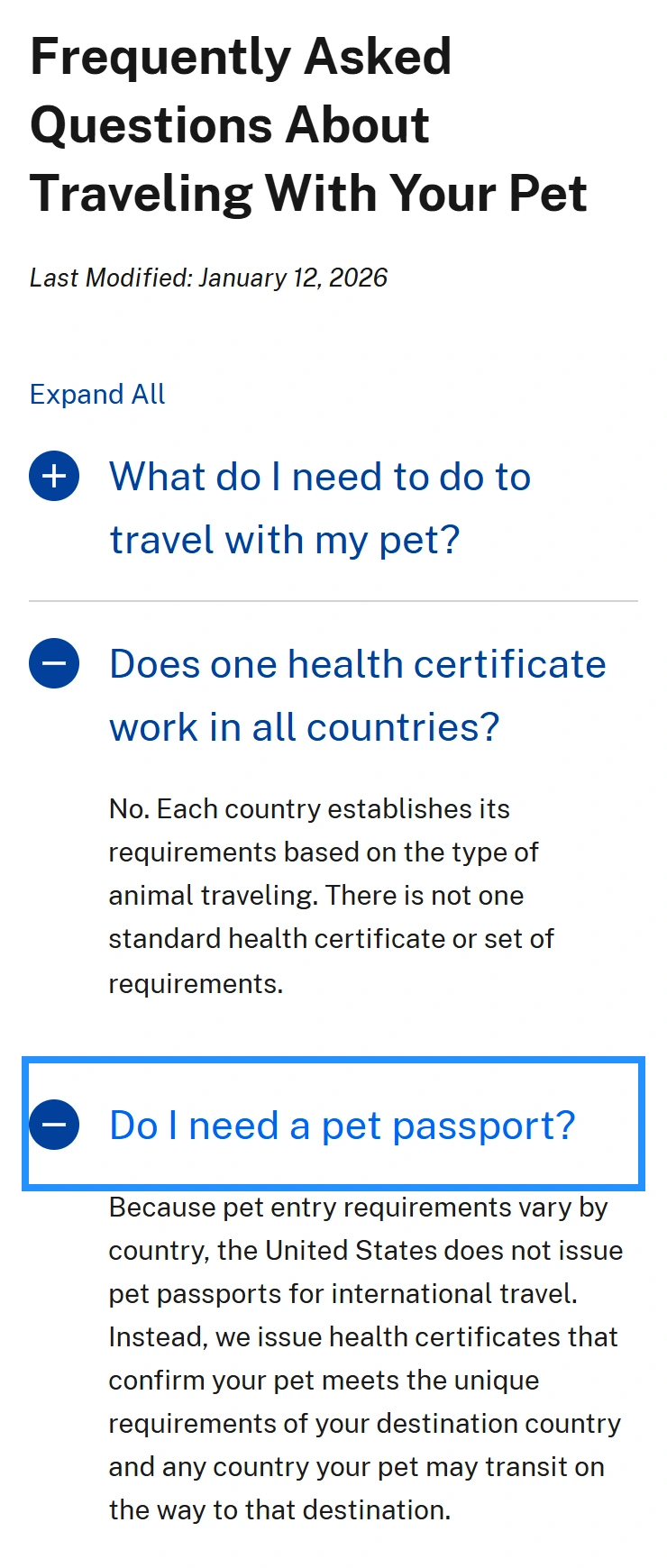
That distinction prevents a common travel-day failure. A booklet called a passport may be a vaccination booklet, clinic record, commercial organizer, or document issued by a country the destination does not recognize. A certificate may be the wrong model, issued by the wrong veterinarian, missing a government endorsement, or outside the permitted arrival window. Verify authority and route before relying on the title.
Choose the document from the route, not the name
Build a route sheet before booking the final veterinary appointment. Include the animal, the person traveling with it, and every border where officials may inspect the animal or documents. The return journey is a separate route and may require work before departure.
- Animal: species, breed when relevant, age, microchip number, current country, and vaccination history.
- Movement: departure country, destination, transit countries, ports of entry, and whether customs will be cleared during a connection.
- Traveler: owner, authorized person, pet shipper, and the time gap between the owner’s trip and the animal’s trip.
- Purpose: private non-commercial travel, sale or transfer, adoption, relocation, competition, or another movement category.
- Schedule: planned arrival, vaccination dates, tests, treatments, certificate issue window, endorsement, and any advance notice or import permit.
Use the destination agriculture, veterinary, border, or animal-health authority as the controlling source. Then check the export authority in the country of departure. For a U.S. departure, the USDA APHIS pet travel check helps locate destination-specific instructions, but the foreign destination still sets its entry conditions. Ask the authorized veterinarian to work from the same current source page and travel dates.
Confirm the veterinarian’s role before paying for the final examination. A clinic may provide routine care without being authorized to issue the export document required for that route. In the United States, a destination that requires APHIS endorsement also requires the issuing veterinarian to hold the appropriate USDA accreditation. Use the accredited veterinarian check to prepare the questions, then verify current status through the official lookup or agency contact.
Record the source URL, page update date if shown, date checked, document name, authorized issuer, endorsement authority, issue window, arrival window, and unresolved questions. If an agency answers a question by email, save the full reply with the route sheet. A note saying only “vet said OK” is difficult to verify at check-in or at the border.
Compare four common route patterns
The table below is a route map, not a substitute for the live instructions. It shows why the same animal may use a passport on one journey and a newly issued certificate on another.
| Route pattern | Document starting point | Boundary to check |
|---|---|---|
| EU country or Northern Ireland to another EU country or Northern Ireland | Valid European pet passport for eligible dogs, cats, and ferrets | Recognized issuer, current identity and health entries, non-commercial journey conditions, and destination-specific treatment |
| Non-EU country entering the EU | EU animal health certificate issued by an official State veterinarian | Issue no more than 10 days before EU arrival, required declaration, owner or authorized-person timing, and designated entry checks |
| United States to another country | Destination-specific health certificate | Correct form, accredited veterinarian, required testing or treatment, and APHIS endorsement only when the destination requires it |
| Entering Great Britain | Document listed by GOV.UK for the country or territory of departure | An EU-issued passport may work on an eligible EU-origin route, while other origins may require a Great Britain pet health certificate and additional conditions |
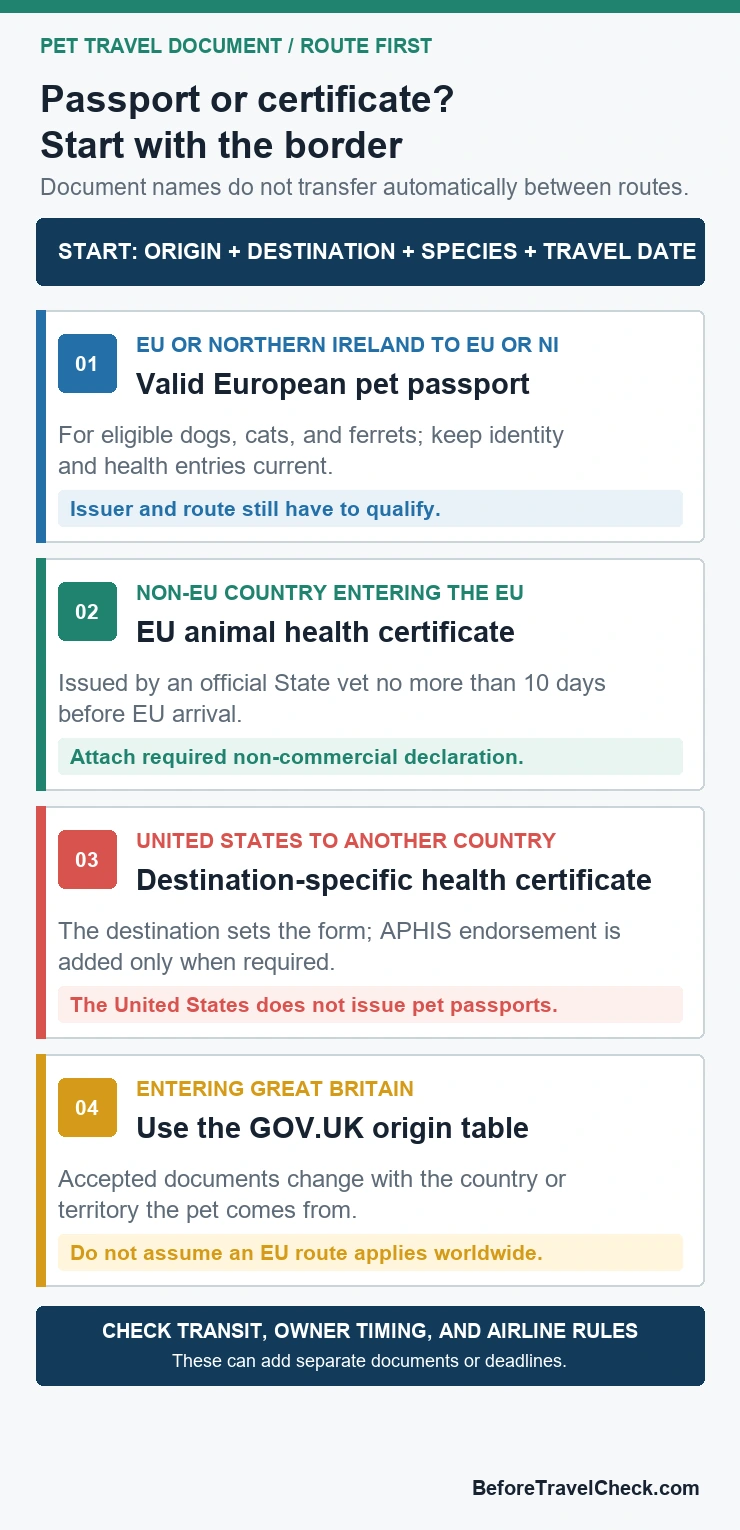
The current EU pet travel guidance describes a European pet passport as an identification document for dogs, cats, and ferrets used for eligible travel between EU countries and Northern Ireland. It also says a traveler entering from a non-EU country uses an EU animal health certificate issued by an official State veterinarian no more than 10 days before arrival in the EU.
The current GOV.UK pet document table starts with the country the animal is coming from. For example, it lists several accepted documents for an eligible EU-country departure, while a pet coming from the United States uses the Great Britain pet health certificate route. Check the complete row and related rabies, tapeworm, route, and arrival instructions rather than copying this example into a different trip.
Build the timeline backward from arrival
The certificate appointment is often near departure, but the preparation may begin months earlier. Work backward from the scheduled arrival time and place every event on one dated line. Do not schedule by phrases such as “valid for ten days” until the official rule says what event starts and ends that period.
- Confirm the full route and return route. Identify the destination authority, export authority, transit countries, approved entry point, carrier, and journey category.
- Verify identification order. For the EU route, the current guidance says the animal must be microchipped before the rabies vaccination used for travel.
- Check vaccination and waiting periods. The current EU guidance states that a first or primary rabies vaccination generally requires at least a 21-day wait before travel. A late booster can be treated as a primary vaccination.
- Add tests, permits, and treatments. Some routes require rabies testing, an import permit, parasite treatment, or other records. EU guidance, for example, gives a 24-to-120-hour window for tapeworm treatment for dogs entering certain destinations.
- Place the examination and issue window. Use the exact destination model and calculate from the arrival event named by the rule, not from when the flight departs.
- Reserve endorsement and delivery time. If the destination requires APHIS endorsement, the issuing veterinarian must be USDA-accredited and the finished package must reach the endorsement process in time.
- Recheck before travel. Confirm that dates, signatures, pages, supporting records, owner travel, carrier booking, and entry point still match the final itinerary.
The EU’s ten-day issue rule is not a worldwide rule. The same warning applies to a passport’s life. EU guidance says a European pet passport can remain valid for life while the health information remains current, but that does not make it valid for every country, species, owner, or route. Put each timing rule beside its source and jurisdiction.
Match every identity, vaccination, and endorsement
Read the completed document as a chain. A correct vaccine on a separate clinic invoice cannot repair a different microchip number on the travel certificate. A government endorsement cannot repair an animal that did not meet the destination’s sequence. Compare the original veterinary records with every field before submission and again after the endorsed document returns.
- Microchip number, scan date when required, animal name, species, sex, breed, color, and date of birth
- Owner or authorized-person name and contact details as required by the model
- Rabies product, batch or lot, administration date, validity dates, and veterinarian entry
- Laboratory test identity, sample date, result, and approved laboratory when the route requires testing
- Parasite treatment product, date, exact time, dosage or administration details, and veterinarian signature when required
- Certificate model, destination, issue date, issuing veterinarian’s authorization, and government endorsement
- All pages, continuation sheets, declarations, import permits, vaccination records, and payment or submission confirmation
Do not publish a scan of a completed passport or certificate to ask for help. It can expose the owner’s address, signatures, veterinarian details, microchip number, certificate number, and travel dates. Share documents only through a channel approved by the responsible veterinarian or agency, and redact only when the recipient confirms that a redacted copy is acceptable for the question.
If the route requires U.S. government endorsement, read the APHIS endorsement guide and the current APHIS instructions for accredited veterinarians. APHIS says the correct current certificate must be used for the species and destination, issued within the required period, and completed with information that matches the supporting records.
Check transit and airline requirements separately
Border permission and carrier acceptance are two different checks. An airline can impose booking limits, carrier dimensions, temperature restrictions, breed restrictions, fitness-to-fly paperwork, or a shorter document window. Those rules do not replace the destination’s import requirements, and government acceptance does not force a carrier to transport the animal.
For U.S. departures, APHIS notes that a carrier may request an additional form even when a country-specific certificate is required. It also explains that APHIS endorses the destination-required certificate, not an extra airline form that the destination does not require. Keep each document labeled by its recipient: border authority, export authority, carrier, or import-permit office.
Check the marketing carrier, operating carrier, aircraft, and each segment. Use the airline pet policy checklist to record who confirmed the booking and when. For a transit country, determine whether the pet stays airside, changes terminals or airports, enters a holding facility, or clears customs. APHIS advises travelers to confirm every border crossed because later-country requirements depend on transportation and time spent in each country.
Owner timing also matters. Current EU guidance allows an authorized person to accompany the pet for a non-commercial movement only under stated conditions, including the owner’s journey within five days. An unaccompanied shipment, sale, transfer of ownership, or movement of more animals than the personal-travel rule allows can move the trip into a different regulatory category.
What to do when the current document is not accepted
Do not add an entry, move a sticker, change a date, copy a signature, or download a different certificate model on your own. Ask the destination authority or authorized veterinarian to identify the exact defect: wrong route, unrecognized issuer, expired vaccination, microchip sequence, missing test, missing treatment, missing declaration, wrong certificate version, endorsement problem, or late issue date.
- Save the rejection message, source page, and the document version reviewed.
- Confirm whether a corrected entry is legally permitted or a new document must be issued.
- Recalculate every waiting period and arrival window after any new vaccination, test, treatment, or certificate.
- Repeat endorsement, import-permit, carrier, transit, and return checks affected by the correction.
- Change the itinerary when the animal cannot meet the rule in time. A booking deadline cannot waive an animal-health requirement.
If the destination’s public instructions do not cover the species or route, APHIS recommends contacting the foreign government authority, embassy or consulate, customs entry point, or ministry of agriculture and obtaining the answer in writing. Share that answer with the veterinarian and anyone responsible for the shipment.
Pet document questions travelers ask
Can a pet passport replace a health certificate?
Only when the live rule for that species, issuer, origin, destination, and journey accepts that passport. A passport accepted for eligible movement within the EU system does not automatically replace a certificate for entry from the United States or another non-EU country.
How long is an EU pet passport valid?
Current EU guidance says it can be valid for life while the health information, such as rabies vaccination, remains in date. The issuing country, owner’s eligibility, route, species, treatments, and journey type must still be accepted.
How long is an EU animal health certificate valid?
For entry from a non-EU country, current EU guidance says it must be issued no more than 10 days before EU arrival. After entry, it can support eligible travel between EU countries for up to six months from that date or until the rabies vaccination expires, whichever occurs first. Confirm the current page and every condition for the actual trip.
Does APHIS endorsement guarantee airline acceptance?
No. Endorsement confirms the government review step required by a destination. The airline can have separate carriage rules and paperwork, so both checks must pass.
Should transit countries be checked?
Yes. Check every border and connection, including whether the animal clears customs or leaves the secure transit area. A transit requirement or first-port inspection can change the document sequence.
For the next step, use the pet travel health certificate guide, the EU pet passport guide, or the Great Britain pet-entry checklist that matches the route. Return to the official source before booking the final appointment.