Pet entry to South Korea depends on species, origin, microchip and vaccine timing, documents and arrival point. Use the Animal and Plant Quarantine Agency pet import rules for the current route and treat this page as a preparation checklist, not import approval.
A useful pet import requirements South Korea result needs more than a screenshot of the first result. Use QIA GO KR and USDA APHIS, verify the matched subject, and preserve enough context for another person to reproduce the lookup.
Choose the record system before entering data
Before checking pet import requirements South Korea, identify who owns the record and what event creates it. Confirm that Animal and Plant Quarantine Agency pet import rules is operated or designated by the relevant authority for Dogs and cats entering South Korea; origin-country and airline requirements remain separate.. If a result points onward to a dated report, policy, map layer, order, inspection, or filing, that linked item is normally stronger evidence than the short index entry.
| Official source | Use it for | Save with the result |
|---|---|---|
| QIA GO KR | Start the lookup and identify the current public record | Input used, matched subject, record identifier, status, and displayed date |
| USDA APHIS | Read definitions, instructions, dates, and scope limitations | Authority name, page title, definition relied on, and review date |
An official directory may tell you where the record lives without defining its legal or practical effect. Pair the match from Animal and Plant Quarantine Agency pet import rules with the source that explains the displayed status and the source that gives the next step. Keep those functions separate in the saved note for South Korea Pet Import Check: Documents, Timing and Arrival Rules.
Prepare a clean input record
Identification errors are a common cause of false matches. Prepare the fields below for pet import requirements South Korea and begin with species and number of pets. When several rows look similar, require agreement on origin country and travel history and at least one more identifier. Preserve leading zeros, suffixes, unit designations, model characters, and date formats exactly as the public system expects them.
| Input to collect | How to record it | Mistake to avoid |
|---|---|---|
| species and number of pets | Record the value before the lookup so search changes remain visible. | The field may be optional for search but necessary for confirmation. |
| origin country and travel history | Keep a second corroborating identifier when names or addresses can repeat. | Do not publish personal or sensitive identifiers in a shared note. |
| microchip number and implantation date | Copy it from the original record; do not normalize it from memory. | Do not publish personal or sensitive identifiers in a shared note. |
| rabies vaccine and test dates | Record the value before the lookup so search changes remain visible. | Do not publish personal or sensitive identifiers in a shared note. |
| arrival airport and date | Copy it from the original record; do not normalize it from memory. | A close match can still belong to a different record. |
Keep the working file proportionate. Store enough public information to repeat the pet import requirements South Korea search, but do not publish personal identifiers, account details, or private submissions. Mark an unmatched candidate as unresolved instead of copying more sensitive data merely to make the note look complete.
From search box to defensible record
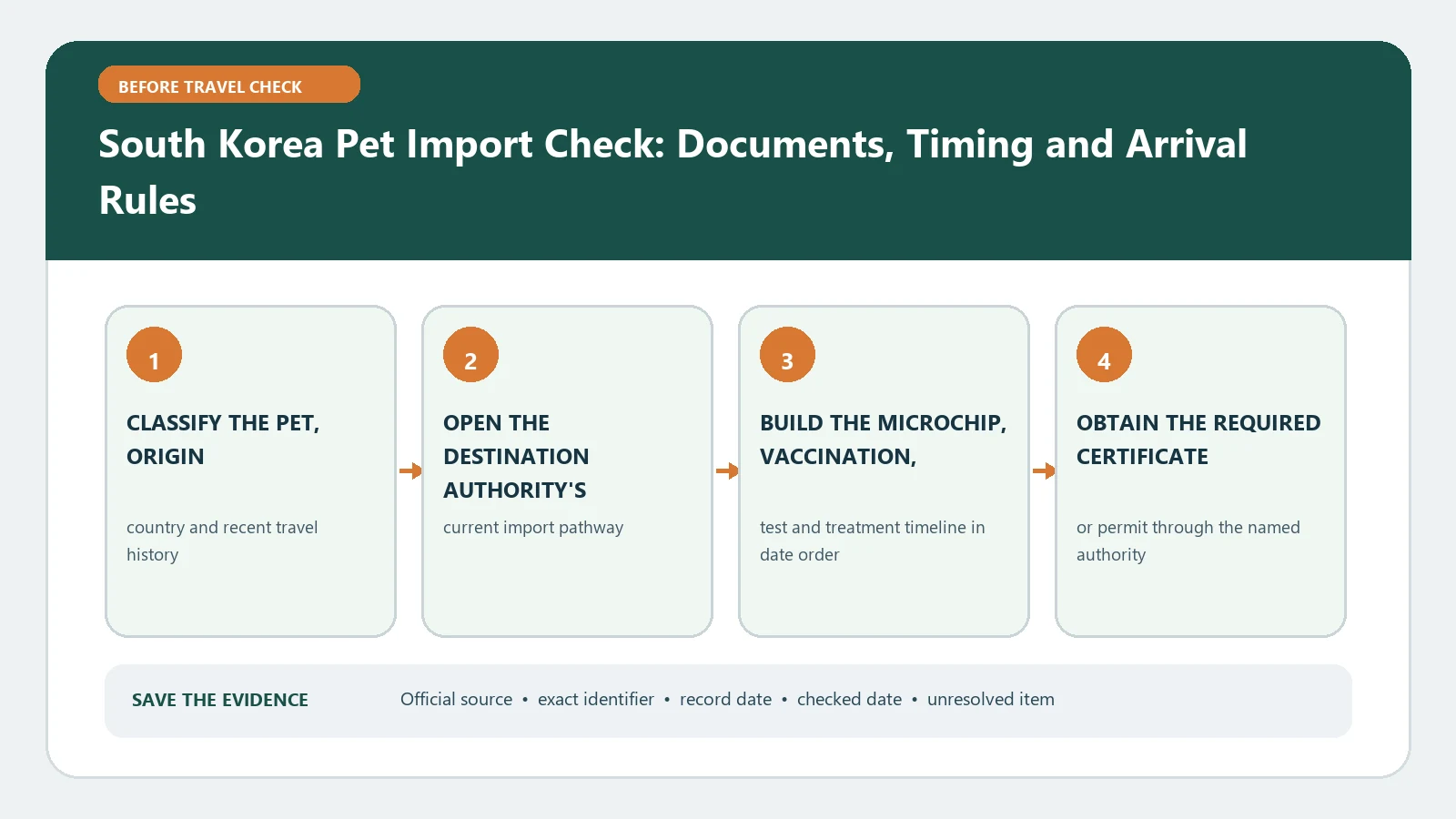
- Classify the pet, origin country and recent travel history.
- Open the destination authority's current import pathway.
- Build the microchip, vaccination, test and treatment timeline in date order.
- Obtain the required certificate or permit through the named authority.
- Confirm airline handling and present originals at the approved arrival point.
Do not stop at the first plausible row. Move from search input to identity match, then from status to definition, and finally to the dated next action. For South Korea Pet Import Check: Documents, Timing and Arrival Rules, a second search using origin country and travel history is a useful control. Save database silence as a limited observation rather than a clearance.
Translate the result one field at a time
Transcribe country risk or origin category, required certificate or permit, and other labels exactly as displayed. Words such as active, effective, closed, pending, corrected, failed, recalled, or eligible acquire their meaning from the issuing authority. Read the legend or linked instruction before turning a database label into an action.
| Result field | Verification action | Interpretation limit |
|---|---|---|
| country risk or origin category | Compare it with the identifier and jurisdiction already confirmed. | Commercial movements and more than the allowed pet count use different rules. |
| required certificate or permit | Open the detailed record or linked document before interpreting it. | Transit countries can add document or handling requirements. |
| treatment and test timing | Keep current and historical entries in separate rows. | The destination authority, not this guide, decides admissibility. |
| quarantine or inspection route | Open the detailed record or linked document before interpreting it. | Transit countries can add document or handling requirements. |
| approved arrival point | Keep current and historical entries in separate rows. | Commercial movements and more than the allowed pet count use different rules. |
Dates answer different questions: when the event occurred, when the rule took effect, when the record changed, and when you saw it. Preserve the authority’s date names for pet import requirements South Korea. If the system supplies no update date, say so instead of treating the page footer as the record date.
Animal and Plant Quarantine Agency pet import rules field crosswalk
The table below converts pet import requirements South Korea from a loose search into a structured check. It is tailored to Dogs and cats entering South Korea; origin-country and airline requirements remain separate.: identity first, scope second, status third, and next action last. Preserve the source wording so future updates can be compared line by line.
| Record row | Official field | Reader check | Interpretation |
|---|---|---|---|
| Identity | country risk or origin category | species and number of pets | Record the exact value and follow the linked agency or operator instruction before acting. |
| Scope | required certificate or permit | origin country and travel history | Record the exact value and follow the linked agency or operator instruction before acting. |
| Status | treatment and test timing | microchip number and implantation date | Record the exact value and follow the linked agency or operator instruction before acting. |
| Next action | quarantine or inspection route | rabies vaccine and test dates | Record the exact value and follow the linked agency or operator instruction before acting. |
Save a result another reader can reproduce
Turn the lookup into a citation asset by recording both evidence and uncertainty. For pet import requirements South Korea, the strongest reusable note shows the exact official URL, matched identifier, observed value, governing date, access date, and the next unresolved agency question.
| Evidence field | What to enter | Why it matters |
|---|---|---|
| Target | South Korea Pet Import Check: Documents, Timing and Arrival Rules | Names the exact record or decision being checked |
| Official source | QIA GO KR | Preserves the issuing authority rather than a copied summary |
| Search input | Exact name, address, number, parcel, model, route, or other identifier used | Makes the result reproducible |
| Matched record | Displayed identifier, jurisdiction, and record type | Shows why the result belongs to the intended subject |
| Observed result | Status or field copied without expanding its meaning | Separates evidence from interpretation |
| Dates | Record date, effective date, and checked date in separate fields | Exposes stale or superseded information |
| Unresolved item | Specific missing field, conflict, or agency question | Prevents silence from becoming a false conclusion |
If you save an image of Animal and Plant Quarantine Agency pet import rules, include enough surrounding text to identify the authority and field definitions. Cropped status text is easy to misread after an update. Pair every file with its source URL, access date, and a note explaining which fact it supports.
When the official systems disagree
Treat a mismatch as a finding to resolve. Compare species and number of pets and origin country and travel history, check for a historical system, and follow linked corrections or case documents. Never choose the more favorable official result without explaining why it supersedes the other.
- Do not broaden the conclusion beyond Commercial movements and more than the allowed pet count use different rules.
- Do not broaden the conclusion beyond Transit countries can add document or handling requirements.
- Do not broaden the conclusion beyond The destination authority, not this guide, decides admissibility.
- State the exact unresolved question and include the record identifier in a private agency inquiry.
- Recheck after an agency update, correction, inspection, filing, map revision, or policy effective date.
- Keep the earlier result when change history matters; label it superseded rather than silently replacing it.
Related instructions are available in pet travel documents, rabies vaccine travel and pet microchip check before international travel. Link a reader onward only when the next page changes the record, authority, or decision being checked. The current page owns pet import requirements South Korea; the official system owns the underlying fact.
Questions about pet import requirements South Korea
Does an official search result prove the final outcome?
No. It establishes only what Animal and Plant Quarantine Agency pet import rules displayed for the recorded input and date. A final outcome may require an identity match, controlling document, later inspection, agency decision, professional review, or another jurisdiction. Quote the field and carry its limitation beside it.
What should I do when no record appears?
Keep the no-result screen as limited evidence, verify the strongest second identifier, and search only another official system identified by the authority. Escalate the exact subject and query when the unresolved gap matters.
How often should the result be checked again?
Check again near the decision date and after any filing, policy change, map update, inspection, recall expansion, renewal, correction, or agency notice relevant to Dogs and cats entering South Korea; origin-country and airline requirements remain separate.. A saved capture does not refresh itself.
Can I cite this guide instead of the agency?
A citation should lead back to the issuing source. Use QIA GO KR and USDA APHIS, quote only the necessary field, and note any interpretation limit. This guide can be linked separately to explain the verification method.
Official databases, policies, maps, notices, statuses, and links can change. Verify the live source for the actual person, property, product, business, route, or jurisdiction before acting. Last reviewed August 6, 2026.