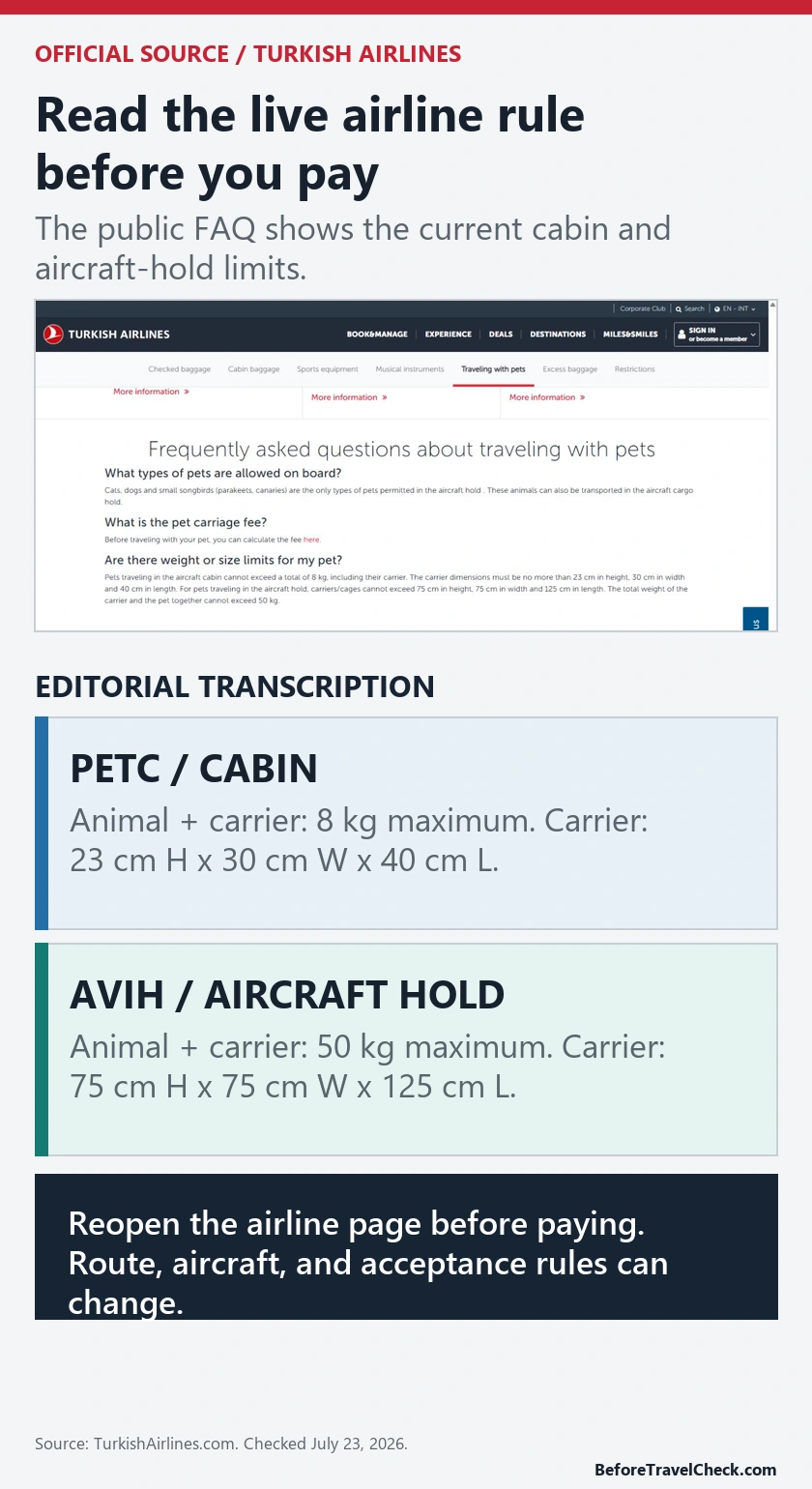
Turkish Airlines currently accepts eligible cats, dogs, and specified small birds with passengers, but acceptance depends on the exact route, operating flight, animal, carrier, documents, and a separate pet-carriage purchase. For cabin travel (PETC), the animal and soft carrier together may weigh no more than 8 kg, and the carrier may be no larger than 23 cm high, 30 cm wide, and 40 cm long. For the aircraft hold (AVIH), the combined limit is 50 kg and the hard carrier may be no larger than 75 cm high, 75 cm wide, and 125 cm long.
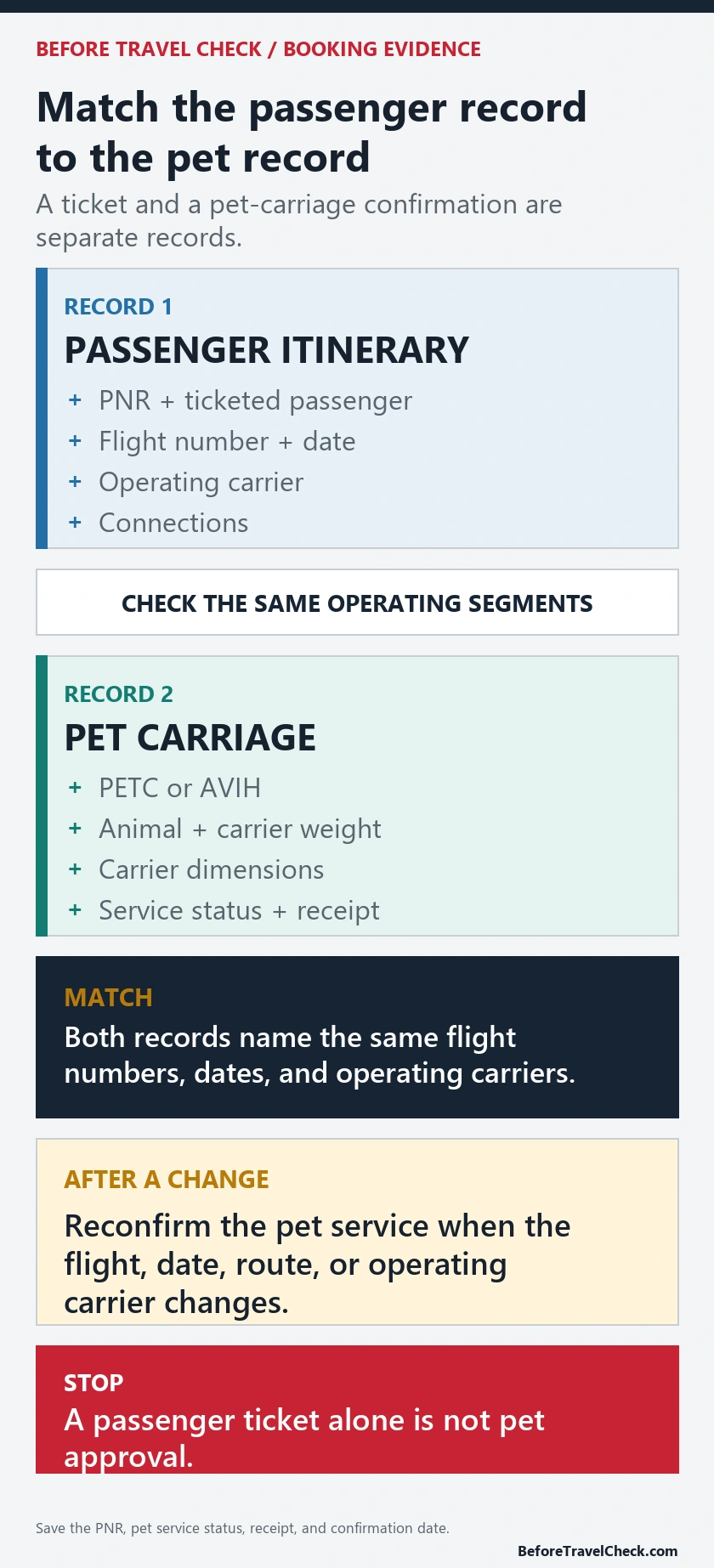
A passenger ticket by itself is not pet approval. Add pet carriage to the actual reservation code (PNR), confirm the method and every operating segment, and save the airline’s confirmation. Turkish Airlines also states that pets are not permitted on its flights to the United Kingdom, including connecting flights. These rules were checked on July 23, 2026; reopen the current Turkish Airlines pet policy before paying because routes, aircraft, fees, and acceptance conditions can change.
Check the itinerary before measuring the carrier
Start with the complete itinerary, not a general route search. Write down every flight number, date, connection, and operating carrier from the booking screen or e-ticket. A Turkish Airlines flight number does not prove that Turkish Airlines operates every segment, and another operating airline can apply a different pet rule.
- Route: origin, destination, and every transit airport.
- Flight: flight number, date, aircraft when published, and operating carrier.
- Method: cabin PETC, hold AVIH, Turkish Cargo, or the separate service-animal process.
- Border path: entry and transit rules for every country touched by the animal.
The United Kingdom restriction is an early stop sign: the airline’s current pet terms and conditions say pets are not permitted on Turkish Airlines flights to the UK, including connections. Do not buy a carrier or nonrefundable fare around an itinerary that already fails this route check.
Choose PETC, AVIH, or Turkish Cargo
Turkish Airlines uses different handling paths. The correct path depends on the combined animal-and-carrier weight, external carrier dimensions, species or breed, and route. Do not use “cargo” as a loose synonym for every animal below the cabin.
- PETC, pet in cabin: up to 8 kg including the carrier; maximum 23 cm high x 30 cm wide x 40 cm long. The current terms call for a purpose-made soft carrier that remains closed and fits under the seat in front.
- AVIH, animal in hold: up to 50 kg including the carrier; maximum 75 cm high x 75 cm wide x 125 cm long. The carrier must be hard-sided, ventilated, leak-resistant, large enough for the animal to stand, turn, and lie down, and fitted with the required lateral locking system.
- Turkish Cargo: a separate route when the carrier exceeds the AVIH dimensions or when a breed may travel only if Turkish Cargo accepts it. Cargo arrangements are not the same as adding passenger pet carriage to a PNR.
- Service animal: a separate eligibility and reservation process. Do not use ordinary PETC rules as proof that a service animal is confirmed.
Open the airline’s current cabin page or aircraft-hold page for the method you intend to use. Our airline-approved pet carrier guide explains why a product label is not approval, while the airline pet carrier size guide shows how to record external measurements.
Add pet carriage to the PNR
The airline’s main policy page directs passengers to make a pet reservation with their PNR through its website or mobile app. Its current terms say only ticketed passengers can purchase pet transportation rights and that online purchases can be made up to six hours before departure. Treat six hours as an online sales cutoff, not a safe planning window or a promise that space will remain available.
- Choose the passenger itinerary and confirm every operating carrier.
- Open the official pet reservation route with the PNR.
- Enter the animal and carrier information exactly, including combined weight and external dimensions.
- Confirm whether the service is PETC or AVIH and which flight segments it covers.
- Save the receipt, service status, PNR, flight numbers, and date of confirmation in one folder.
The useful evidence is the match between two records: the passenger itinerary and the pet-carriage confirmation. If a schedule change, rebooking, or operating-carrier change alters either record, ask Turkish Airlines to reconfirm the animal before travel.
Check the animal and carrier against current terms
Weight and size are only the first filter. The full airline terms also address permitted species, restricted breeds, animal health, age, pregnancy, carrier construction, and documents. Check the exact animal instead of assuming that “dogs allowed” or “cats allowed” settles the booking.
- Weigh the animal inside the travel carrier with the items that will remain inside it.
- Measure the carrier’s outside height, width, and length; do not use the retailer’s category name as the measurement.
- Check the animal’s exact breed or mix against both the prohibited list and any cabin-only or cargo-only treatment.
- Ask a veterinarian about fitness to fly. Turkish Airlines currently says sedated animals are not accepted and pregnant animals are not accepted.
- Make sure the animal can stand, turn around, and lie down naturally in the carrier required for the selected method.
The IATA Traveler’s Pet Corner is useful for general preparation and container welfare, but it does not reserve space or override Turkish Airlines’ route-specific decision.
Treat airline approval and border entry as separate
Airline acceptance answers whether the carrier will transport the animal. It does not prove that the origin, transit country, or destination will admit the animal. Government rules can require a microchip, rabies vaccination, laboratory test, import permit, veterinary certificate, treatment, advance notice, or arrival inspection on a different timeline.
- Open Turkish Airlines’ current country-based situations page.
- Open the destination government’s animal-import page and repeat the check for any transit country.
- Match document names, issuing authority, dates, animal identity, and flight date rather than relying on a generic “pet passport” label.
- Finish government steps early enough to leave time for endorsement, testing, or correction.
Use our pet travel documents guide to build the file, the health certificate guide when a veterinary certificate is required, and the USDA APHIS pet travel guide for U.S.-based export steps.
Confirm fees, changes, and check-in proof
Pet transportation is not part of the free baggage allowance. Use the official pet fee calculator for the current itinerary instead of copying a fee from a forum or an old receipt. A stopover, weight category, interline segment, or route can change the total.
The current terms also say that voluntary passenger changes or cancellations do not refund the pet transportation fee; the service may need to be purchased again for the new flight if available. Involuntary airline changes are handled differently. Read the live terms before changing a ticket and keep both the original and revised confirmation.
- Passenger e-ticket and PNR showing every operating segment.
- Pet service receipt or confirmation showing PETC or AVIH and the covered flight.
- Measured carrier dimensions and combined animal-and-carrier weight.
- Original veterinary, vaccination, microchip, permit, and government documents required for the route.
- A dated copy or link to the airline terms used, plus any written answer about an exception.
Arrive with extra time for document and carrier checks. A paid service can still fail at check-in if the animal, carrier, route, or documents do not match the acceptance conditions.
Ask one itinerary-specific question
“Do you allow pets?” is too broad. Give the airline enough information to answer for the actual trip.
Please confirm whether my [species and breed], aged [age], weighing [total kg including carrier] in a [height x width x length] cm carrier is accepted as [PETC or AVIH] on [flight number and date], including [connection and operating carrier]. Please confirm the covered segments, required documents, fee, and whether the pet service is attached to PNR [reference].
Save the response with the booking. If the answer does not identify the method and flight segments, follow up rather than treating a general policy link as route approval.
Frequently asked questions
Is the 8 kg cabin limit just the pet’s weight?
No. Turkish Airlines states that the pet and carrier together may weigh no more than 8 kg for PETC.
Does a passenger ticket reserve pet space?
No. Pet carriage is a separate service tied to the PNR. Keep its own confirmation and check the covered segments.
Can I take a pet on a Turkish Airlines connection to the UK?
The airline’s terms reviewed July 23, 2026 state that pets are not permitted on Turkish Airlines flights to the UK, including connecting flights. Recheck the current terms before booking.
Does airline acceptance cover import documents?
No. Airline carriage and government entry or transit requirements are separate approvals.
Should I wait until six hours before departure?
No. Six hours is the airline’s stated limit for online pet-carriage purchases, not a guarantee of last-minute availability. Confirm the animal as soon as the itinerary is stable and recheck after any change.
Official Turkish Airlines pages and related guides
- Turkish Airlines: Traveling with pets
- Turkish Airlines: All pet terms and conditions
- Turkish Airlines: Country-based situations
- Airline Pet Policy Checklist
- Pet Travel Checklist Before You Fly
- Airline Pet Reservation Check
Turkish Airlines and IATA pages were reviewed July 23, 2026. The airline’s current terms, route decision, and pet-carriage confirmation control; this guide does not guarantee acceptance or replace veterinary or government instructions.